 By the NAXTECH team · Published 23 Sept 2026 · Updated 3 Nov 2026 · Hands-on with v1.6
You have an NFC sticker that works — the one by the door that opens your smart-home scene, the tent card that loads your café menu — and you want a second one that does exactly the same thing. Most "NFC" apps either read a tag and stop, or let you write from scratch but never copy. And half of them let you scan a bank card, spin a progress bar, then fail with no explanation. NFC Clone closes that gap: read the original, write a blank, and tell you the truth up front about what can and can't be copied.
The whole job runs on your phone's own NFC radio — no cables, no account, no cloud. You hold the original tag to the back of the phone, hold a blank tag in the same spot, and the data moves across.
The frustration with every other copy app is that it lets you try the impossible. NFC Clone reads the tag first and sorts it into one of four verdicts: Copyable, Can't copy, Empty tag or Locked. Bank and credit cards, office and door access cards, hotel keys, transit cards and car keys are all encrypted with a fixed UID — no phone app can clone them, not this one and not any other. NFC Clone says so the instant you scan one, instead of letting you waste a blank tag finding out.
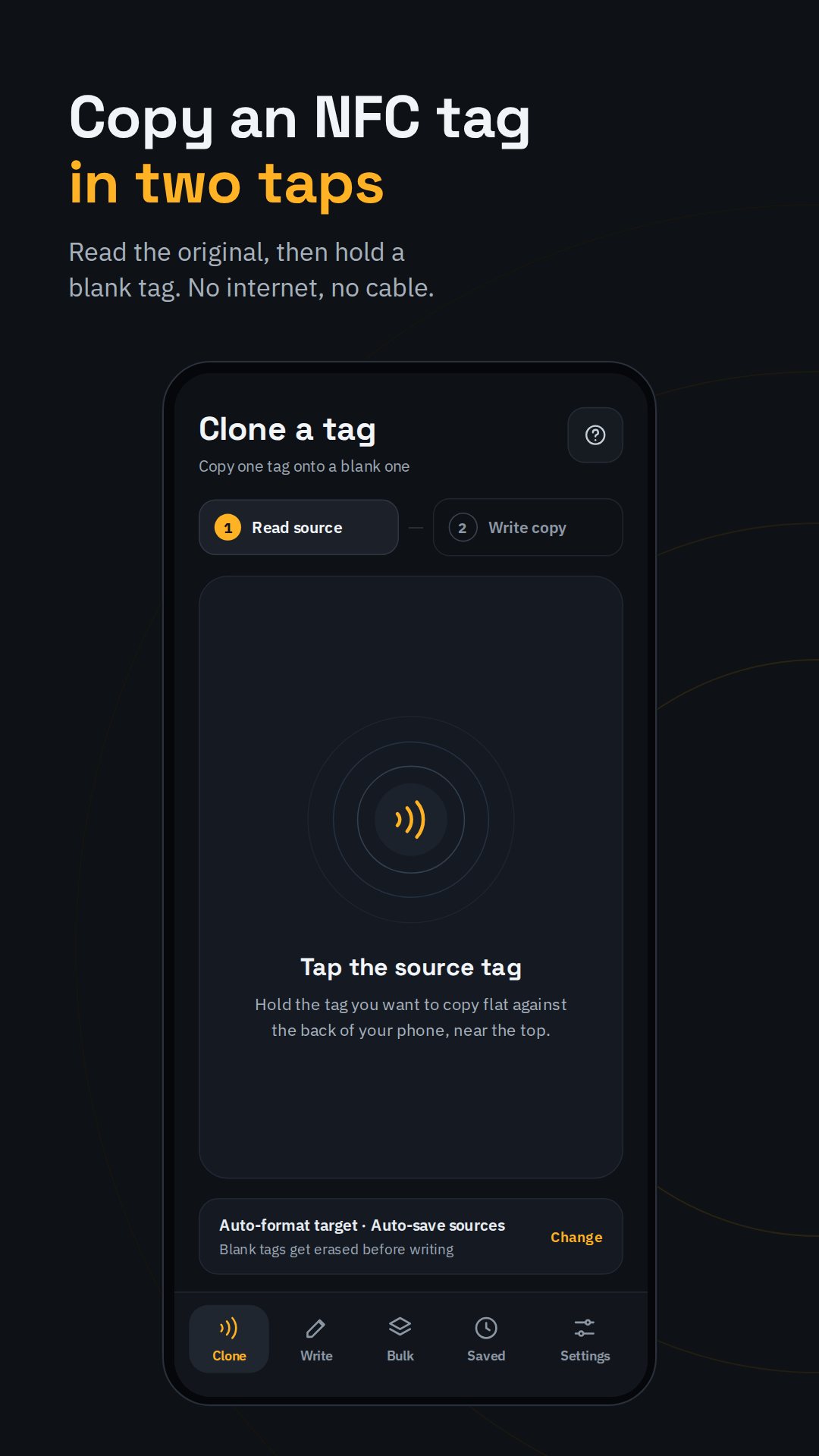
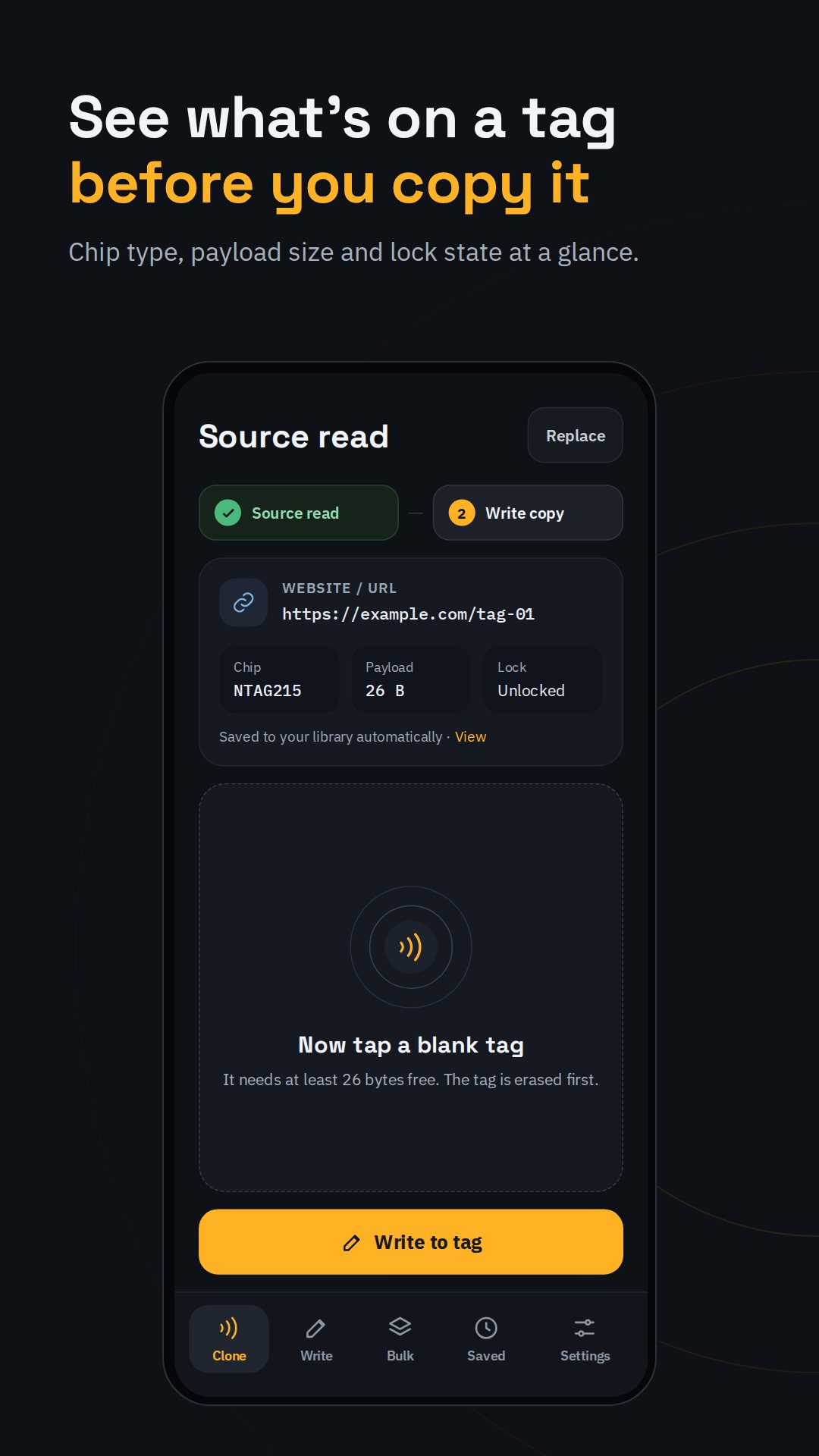
Scan a tag and the card-check screen shows what it actually is: the chip model (NTAG213, 215 or 216), the manufacturer, the full UID, whether it is writable, and the data size in bytes used of the total. That last number matters — the app tells you how many bytes your copy needs, so you know whether an NTAG213 is enough or you need the roomier 215 or 216. After every write it reads the new tag back and confirms the copy matches the original.
Beyond copying, the Write tab turns a blank tag into a tap action. Choose from eleven payload types — Website link, Wi-Fi, Contact card, Text, Social profile, Location, Phone call, Email, Text message, Open an app, or raw Custom (hex). There are tag tools alongside it: Erase a tag, Read info on one, or Lock it permanently so no one — including you — can ever change it again.
Bulk mode is built for the moment you need more than one: set a count, and it walks you through holding blank after blank, vibrating as each finishes so you can swap in the next — and any tag that moved too soon can be redone on its own. Tags you copy can be saved on the device with a name you choose, and optional voice guidance speaks each step aloud so you can keep your eyes on the tag instead of the screen.
NFC Clone asks for the NFC permission and nothing else — no contacts, photos, location or file access. The copy works with no connection; the app touches the internet only to show ads that keep it free, which an in-app purchase removes. Note that fully encrypted cards (banks, hotels, transit, car keys) cannot be cloned by any phone, and a tag you choose to lock can never be changed again.
No. Those are encrypted with a fixed UID that no phone app can clone — NFC Clone detects them and tells you right away instead of failing silently.
Any writable NTAG213, NTAG215 or NTAG216 sticker, card or keyfob; the app shows how many bytes your copy needs so you can pick a size that fits.
No. Reading and writing tags runs entirely on your phone's NFC chip, offline; the internet is only used to show ads that keep the app free.
Yes. Bulk mode copies one original to many blank tags in a single run, and lets you redo any tag that didn't finish.
Get NFC Clone on Google Play →
 By the NAXTECH team · Published 17 Feb 2026 · Updated 20 Aug 2026 · Hands-on with v2.0
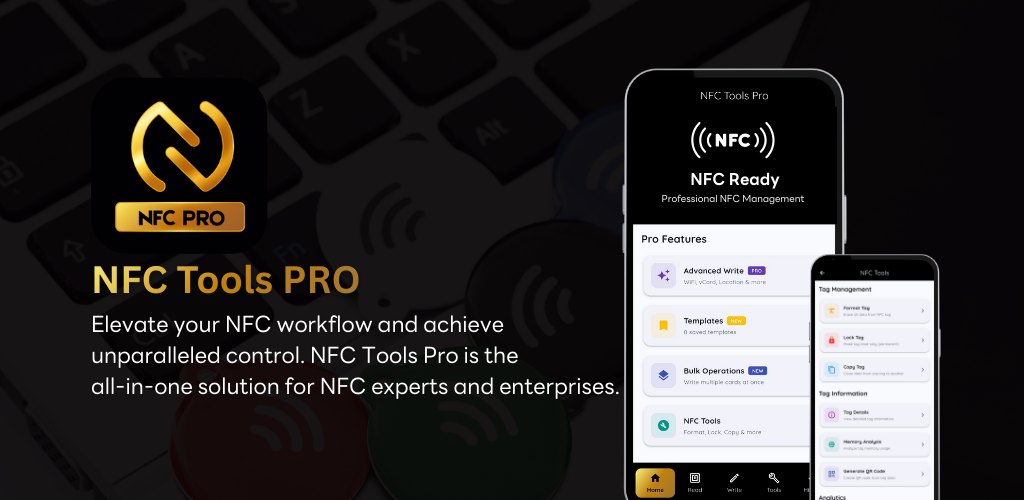
You bought a pack of NFC stickers to do something clever — share your Wi‑Fi with a tap, drop a review link on the counter, open an app by the car dock — and then every "NFC writer" you try either can't fit the data, can't lock the tag, or quietly needs an account. NFC Tools Pro was built to be the one app that handles the whole job, start to finish, on the phone already in your hand.
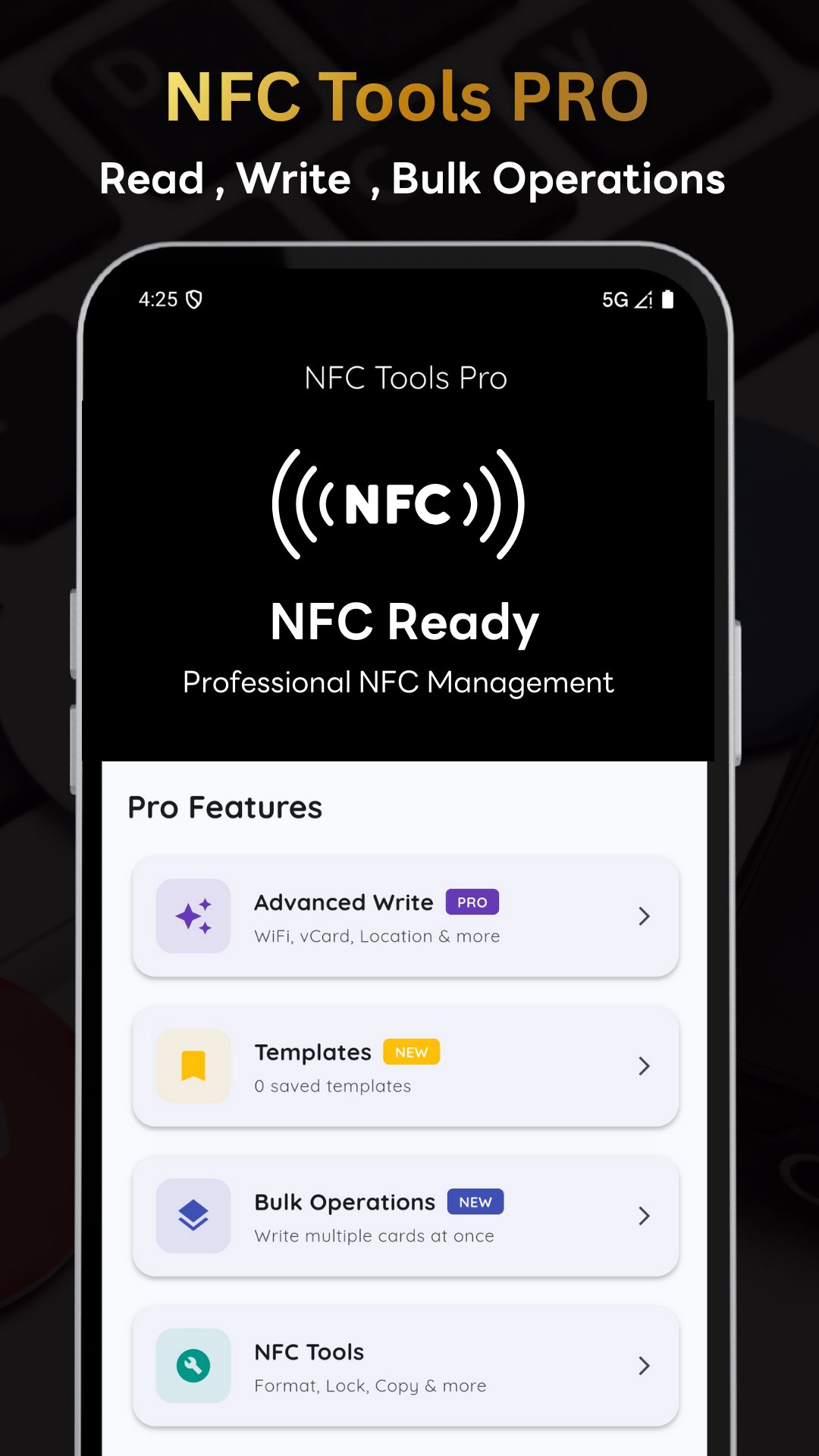
It reads what's on a tag, writes the record you need, and gives you the professional tools — lock, password, clone, memory map — to finish properly. Everything runs on device and offline, so a tag you program at the shop counter never waits on a signal.
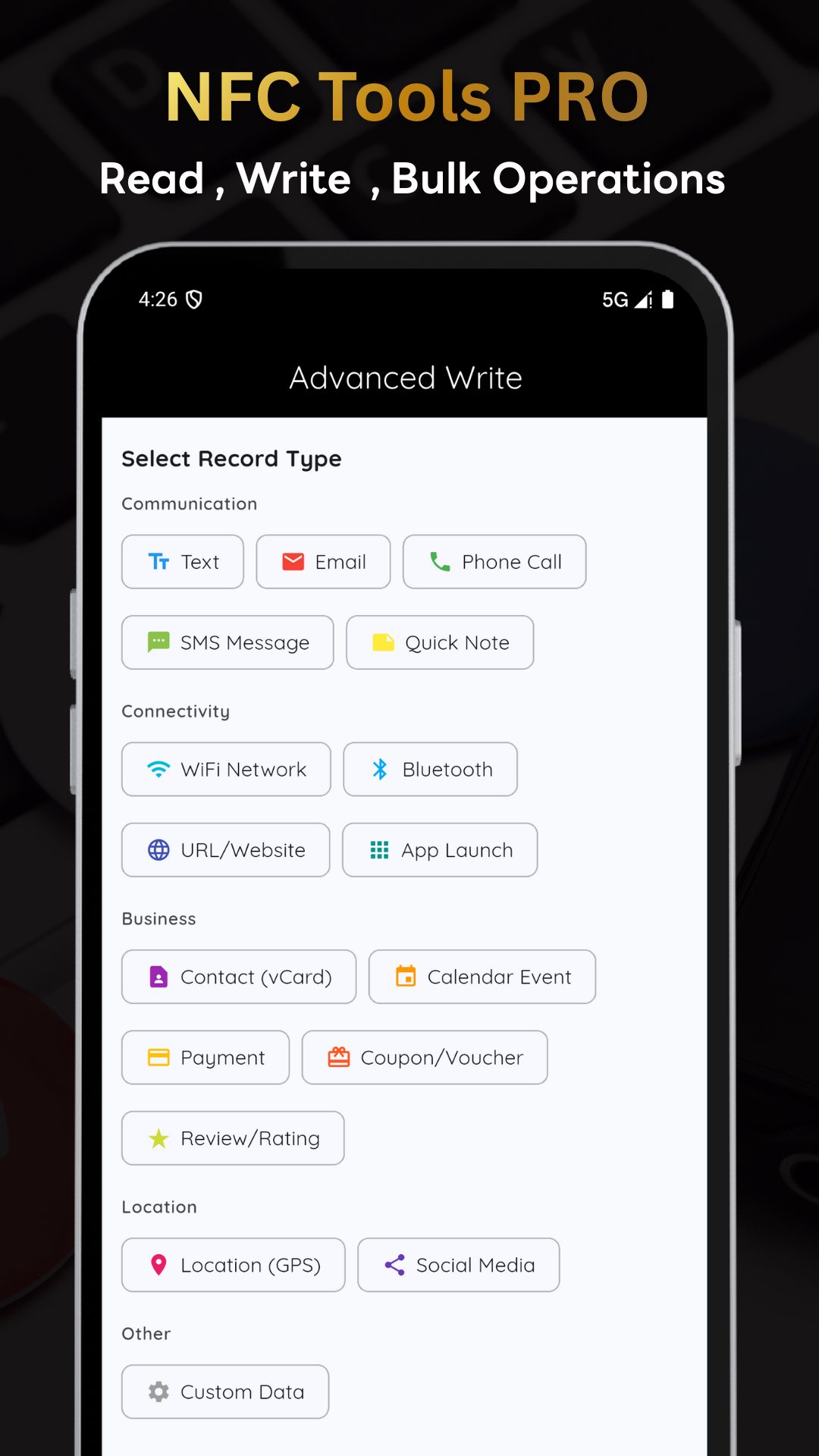
The Write screen lays out 15 record types in three tabs. Everyday covers Website, Text, Call, SMS and Email. Connect adds Wi‑Fi (a real WSC credential, so a guest just taps to join), Bluetooth pairing, Open app, Location, and a Social profile link. Business rounds it out with a vCard Contact, a calendar Event, PromptPay, a Coupon code and a Google Review link. You can stack several records onto one tag, and a running byte counter warns you in red the moment the payload won't fit.
Scan a tag and the Read screen names the chip and shows its UID, and it can read the contents aloud through your device's text-to-speech in the app's current language. The Details tool goes deeper — technologies (NfcA, MifareUltralight, Ndef), ATQA, SAK, user-memory capacity, bytes used, writable and locked state. The Memory map paints every 4‑byte page so you can see exactly how full an NTAG213 (144 B), NTAG215 (504 B) or NTAG216 (888 B) is.
Bulk mode is where NFC Tools Pro earns the "Pro". Paste a list of values, import a CSV, or use Repeat mode to write the same payload across a run of up to 500 tags, tapping one after another while the app tracks progress. There's a Read-batch mode too, for collecting UIDs from a stack of tags, plus a history log of everything you've read and written.
NFC Tools Pro needs no account and keeps its templates, history and batches on the device. The interface ships in ten languages — English, Spanish, Portuguese, German, Japanese, Korean, Thai, Indonesian, Malay and French — and the read-aloud voice follows whichever you pick.
Writing needs a phone with NFC and a tag that still has free, unlocked memory. Locking a tag is permanent, and a password protects an NTAG21x tag rather than encrypting it, so treat both as one-way steps. The app contains ads, with optional in-app purchases.
Yes. Reading, writing, cloning and every tag tool run on your device with no account and no connection.
It writes NTAG213, NTAG215 and NTAG216 stickers, and reads a wider range including MIFARE Classic and Ultralight.
Yes. Paste a list, import a CSV, or use Repeat mode to write the same record across up to 500 tags in one run.
It makes the tag permanently read-only so no one can overwrite it; the app warns you because the change can't be reversed.