 By the NAXTECH team · Published 29 Jul 2026 · Updated 27 Oct 2026 · Hands-on with v2.0
It is the night before the exam, you are staring at a photocopied periodic table, and you still cannot reliably name the symbol for antimony — let alone balance the equation on question four. A wall chart tells you where an element sits; it does not help you remember it, and it certainly will not do the arithmetic. Periodic Table was built to be the one app that closes that whole gap: look something up, understand why it behaves the way it does, drill it until it sticks, and run the calculation — without ever leaving the app or going online.
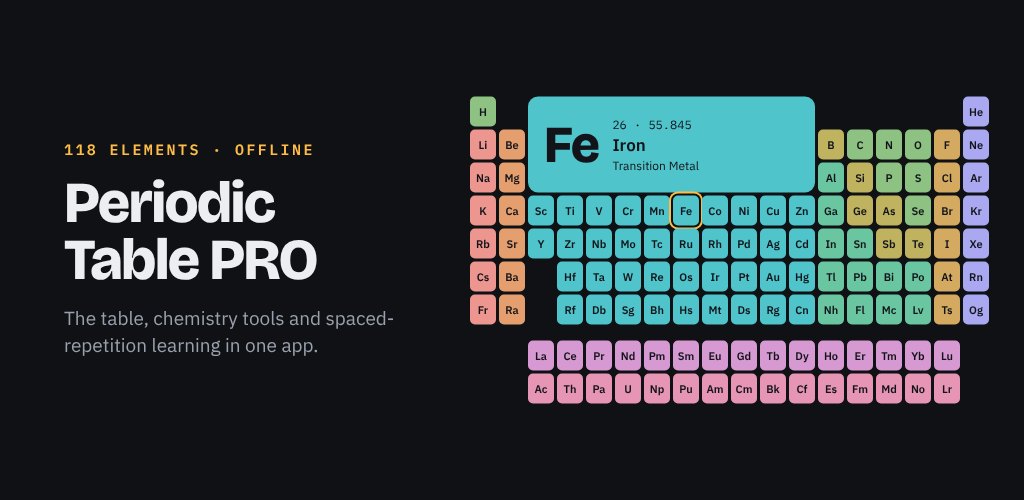
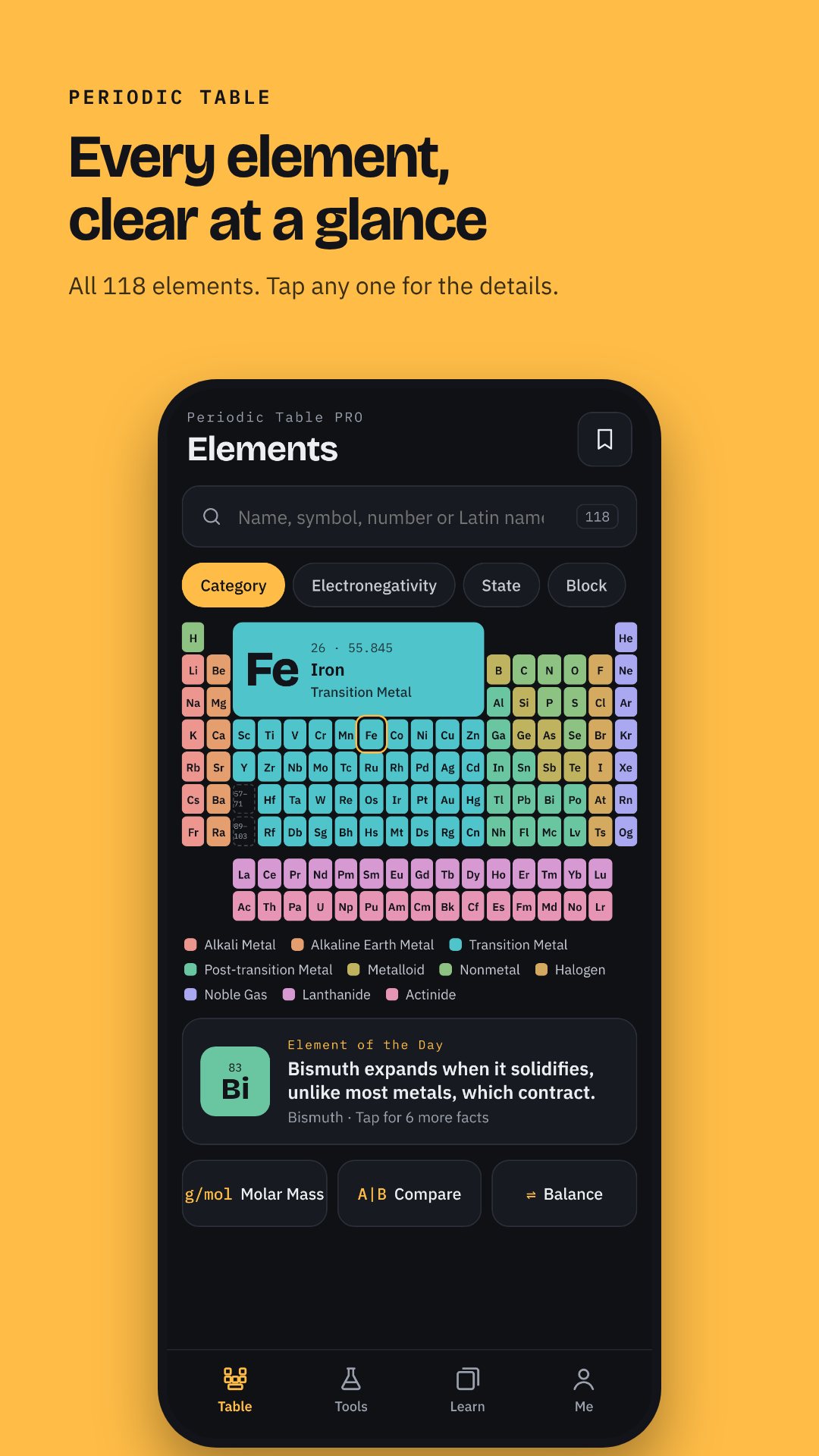
At its core is a clean, colour-coded table of all 118 elements, grouped by family — alkali metals, halogens, noble gases, lanthanides and the rest — so the trends are visible before you tap anything. Everything runs on device, with no sign-in and no permissions requested, so it works just as well in a lab basement as on the bus.
Tap any tile and the element opens to a full card split into Data, Isotopes and Safety tabs. The Data tab shows atomic number and mass, electron configuration, electronegativity, melting and boiling points, density, oxidation states and ionization energy, plus who discovered it, when, and where the name comes from. A built-in Bohr model draws the electron shells for you, and an NFPA safety diamond shows the health, flammability and reactivity ratings at a glance. The Isotopes tab lists every isotope with its half-life and decay mode.
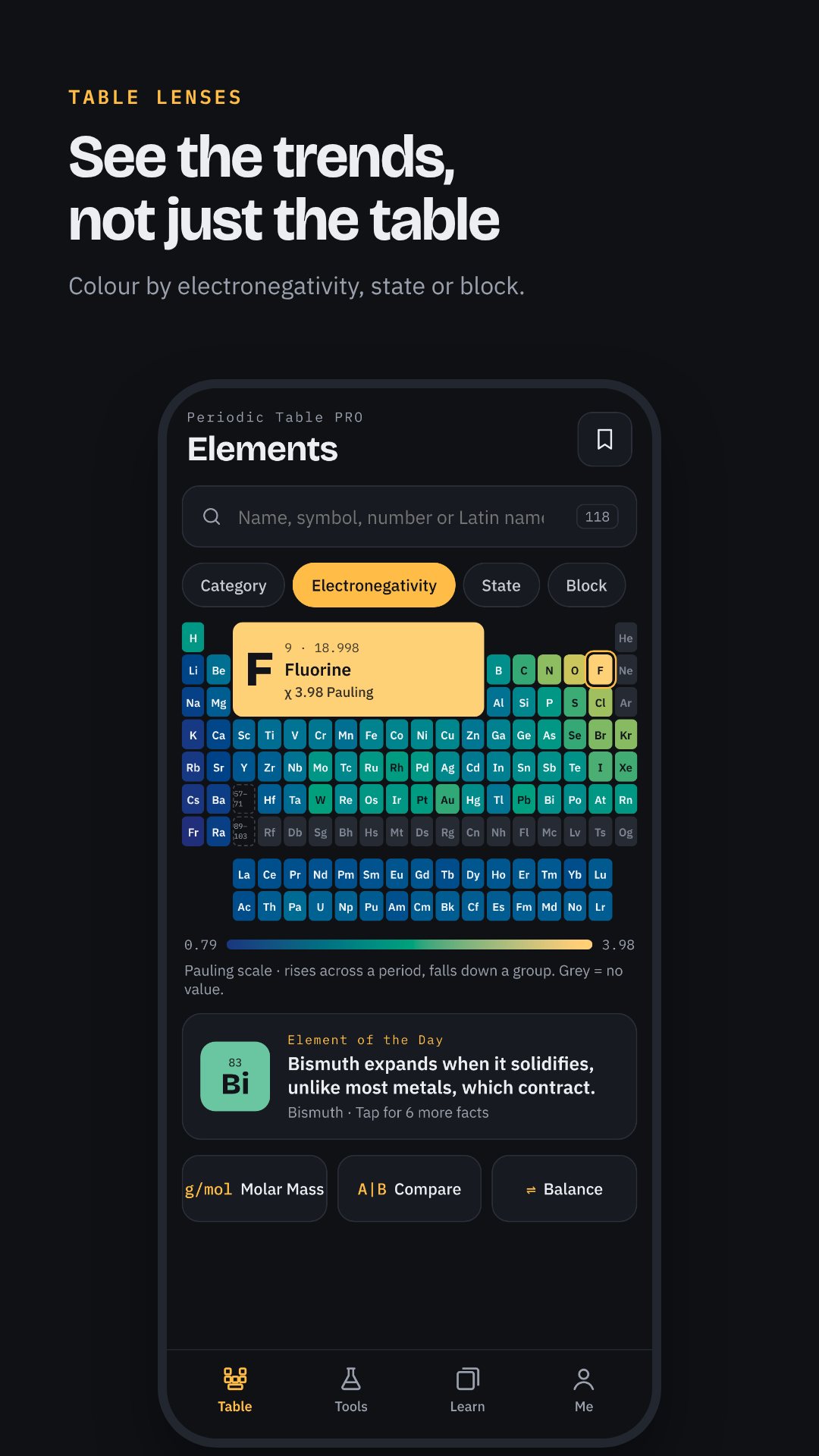
Pick any two elements side by side and the Compare view does more than stack their numbers. A "Why they differ" note explains the trend in plain language — why an element further along the same period is a smaller atom that holds its electrons more tightly, or which of two elements pulls bonding electrons more strongly and in which direction a bond between them leans. It turns the table from a lookup into a periodic-trends tutor.
The Learn tab is a proper study system, not a gimmick. It uses Leitner-box spaced repetition — six boxes with review intervals of 0, 1, 3, 7, 16 and 35 days — so cards you know well come back less often and the ones you keep missing come back fast. A mastery map colours all 118 elements by how well you know them, each day serves a short mixed session of symbols, names, numbers and families, and a streak counter keeps you honest.
The Tools tab carries the working chemistry you actually need. A molar mass calculator with a chemical keyboard parses any formula, an equation balancer shows the balance step by step, a mole ⇆ gram converter handles particles too, and a solutions calculator covers molarity and dilution. Alongside them sit four reference databases: an interactive solubility table of anions against common cations, a pH indicator database with 22 indicators and their colour changes, a searchable reaction database of 60 common reactions, and the full isotopes and half-lives tables.
Periodic Table works entirely offline and asks for no device permissions, so nothing you do leaves your phone. The interface and element data are available in eleven languages. The app is free and contains ads, with an optional Pro in-app purchase that removes ads and unlocks the full practice modes and unlimited calculator use.
Yes. All 118 element cards, the calculators, reference tables and the spaced-repetition learner run on your device, with no account and no internet connection required.
It uses Leitner-box spaced repetition with six boxes and review intervals of 0, 1, 3, 7, 16 and 35 days, so elements you know resurface less often and weak ones come back sooner.
A molar mass calculator, a step-by-step equation balancer, a mole-to-gram converter and a solutions calculator, plus solubility, pH indicator, reaction and isotope reference tables.
Yes, it is free to download with ads, and offers an optional Pro in-app purchase that removes ads and unlocks the full set of practice modes.