Tasbih Rezeki: a dzikir counter built around rizq, timing and your own name
 By the NAXTECH team · Published 10 Mar 2026 · Updated 19 Sept 2026 · Hands-on with v1.0

Tasbih Rezeki at a glance
- What it is
- A digital tasbih (dzikir counter) focused on rizq and debt relief.
- Platform
- Android · fully offline, no account, no sign-in.
- Price
- Free, with ads and an optional rewarded VIP pack.
- Core tools
- Counter · 14 rezeki dzikir · 99 Names · Abjad name wird · Dhuha radar · reminders.
- Languages
- Indonesian, Malay, English and Arabic (right-to-left).
- Best for
- Muslims who want a consistent rezeki wird with the right count at the right hour.
You know the wird you want to keep, but the phone keeps getting in the way. You lose count halfway, you are not sure whether to recite it 14 or 300 times, and by the time you remember it is already past the Dhuha window. A tally counter solves none of that. Tasbih Rezeki was built for exactly this gap: a counter that already knows the dzikir, the target and the best time of day.
It is a digital tasbih organised around rizq (provision) and debt relief, computed entirely on your device — so a session at Fajr or in the last third of the night never waits for a signal.
A counter that counts the way you recite
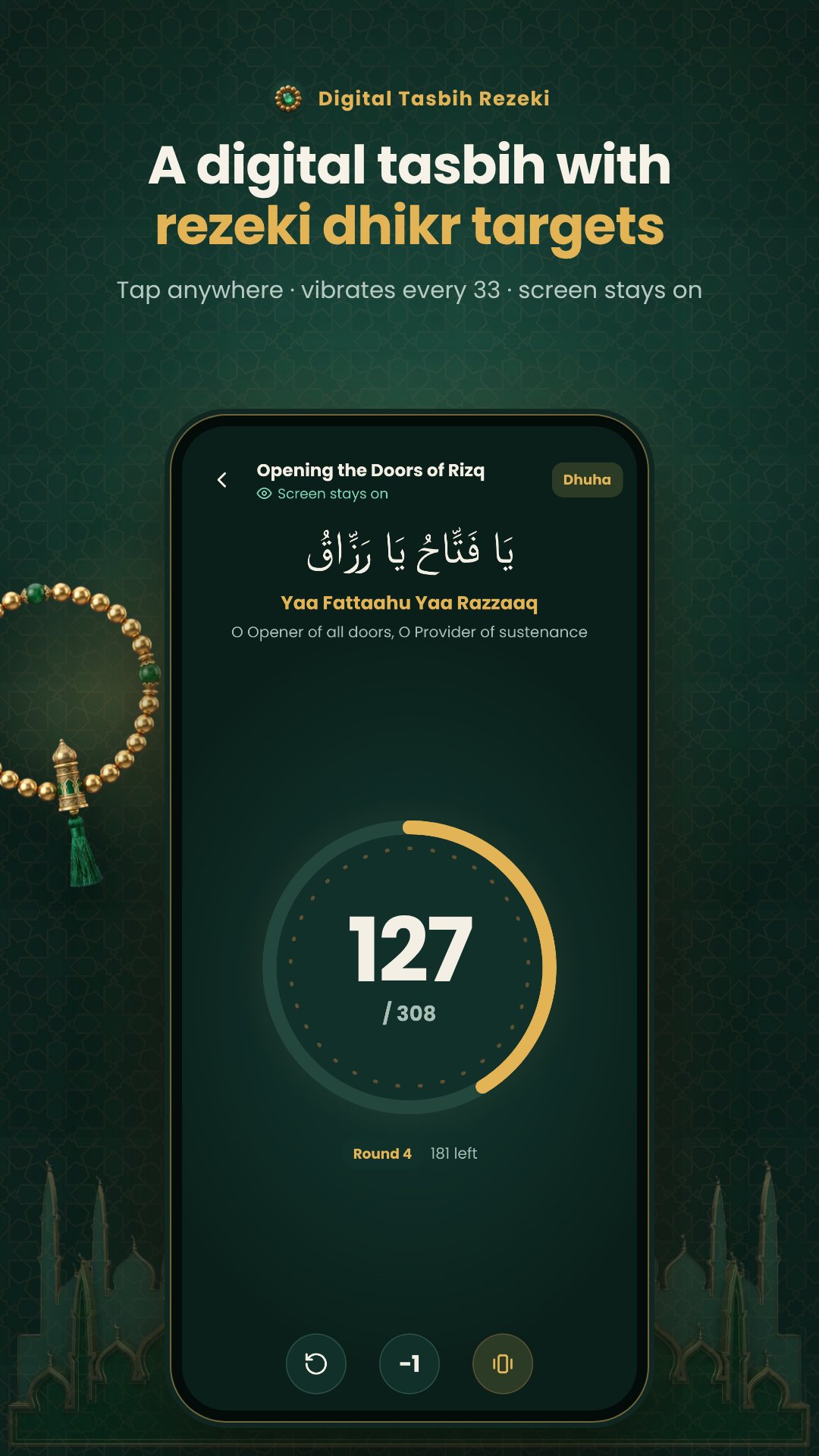
Tap anywhere in the ring to count, or count with the volume keys so you can keep your eyes closed. A gentle haptic tick marks each bead, a stronger buzz marks the end of a round, and a distinct pattern tells you the target is reached — no need to watch the screen. The app keeps the screen awake while you count, saves your progress per dzikir for the day so you can stop and resume where you left off, and offers a dimmed Tahajud night mode that hides the banner for sessions in the dark.
Fourteen rezeki dzikir, with the target already set
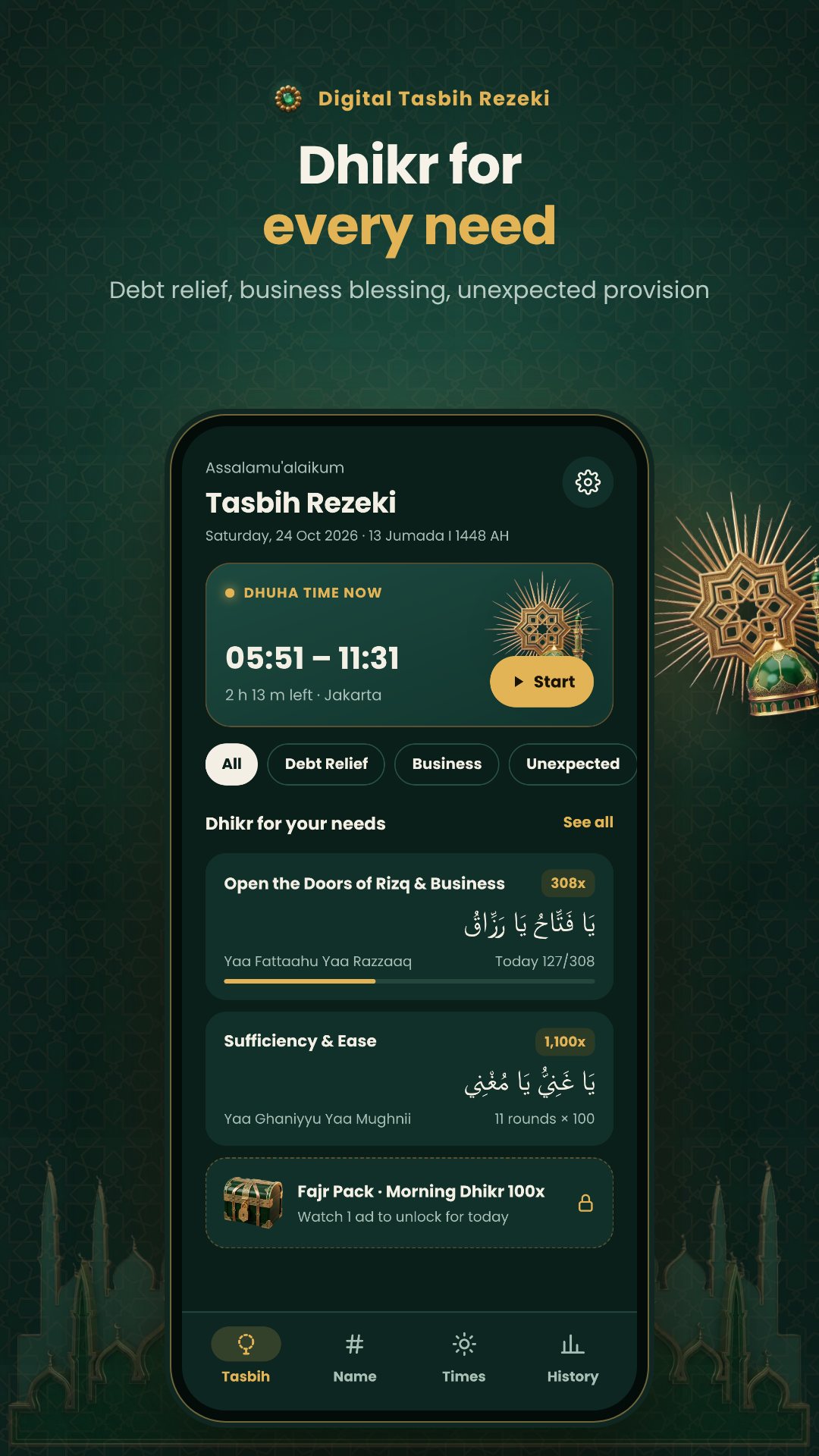
The library ships 14 built-in rezeki dzikir — from Yaa Fattaahu Yaa Razzaaq for opening the doors of provision to Yaa Ghaniyyu Yaa Mughnii for sufficiency and relief from debt. Each one carries the Arabic, a Latin transliteration, the meaning, and a recommended count drawn from traditional practice (often the Abjad value of the Name — for example Razzaq = 308). Every benefit is phrased as a du'a and ikhtiar — asking Allah — never as a promise of money or a guaranteed result. You can also add your own custom dzikir with its own target.
Your name, turned into a personal wird
This is the feature that sets the app apart. Type your name, let the Hisab al-Jumal (Abjad) engine spell it in Arabic — correcting the spelling if needed — and it computes the name's numeric value, then matches it to the nearest of the 99 Names of Allah. The jalal (names of majesty) are deliberately excluded, so a rezeki seeker is never handed a name like Al-Mumit. You get a personal Name to recite, its Abjad breakdown letter by letter, and a suggested count — a wird tailored to you.
The Dhuha radar: the right time, computed offline
Timing matters in this tradition, so the app includes an offline Waktu Dhuha & Mustajab radar. It computes sunrise and prayer times on device using recognised conventions — Kemenag, JAKIM, Muslim World League, Umm al-Qura and the Egyptian Authority — and marks the Dhuha window (roughly sunrise + 20 minutes to just before Dhuhr, with a prime 08:00–11:00 band), plus the last third of the night for Tahajjud. Pick from 41 built-in city presets across Indonesia, Malaysia, Singapore, Brunei and the MENA region, or use your location, and see a tabular Hijri date alongside.
Reminders, streaks and a share card
- Rolling reminders — a 7-day window of nudges for the morning (Pagi), Dhuha, Tahajud and Friday (Jumat), that survive a reboot.
- Streaks & stats — daily totals and history so a habit becomes visible.
- Share card — render a 9:16 story image of a dzikir to share.
- Four languages — Indonesian, Malay, English and full right-to-left Arabic.
How to start a rezeki wird in Tasbih Rezeki
- Open the library and pick a rezeki dzikir, such as Yaa Fattaahu Yaa Razzaaq.
- Read the Arabic, transliteration and meaning, then tap through to the counter.
- Count by tapping the ring or pressing a volume key, feeling each haptic tick.
- Let the buzz tell you when the target is reached, then save the session to your history.
- Check the Dhuha radar and set a reminder so tomorrow's wird lands in the golden window.
Good to know
Tasbih Rezeki needs no account; it asks for location only to compute your local prayer times and for notification permission to send reminders. Its copy is written as du'a and ikhtiar — it never promises wealth or guaranteed outcomes. It is free with ads, plus an optional rewarded VIP pack.
Frequently asked questions
Does Tasbih Rezeki work offline?
Yes. The counter, the 99 Names, the Abjad name wird and the Dhuha prayer-time radar are all computed on your device, with no connection required.
Can I count with the volume buttons?
Yes. You can tap the on-screen ring or press a volume key to count, with haptic feedback for each bead, each round and the target.
How does the personal name wird work?
It spells your name in Arabic, computes its Abjad (Hisab al-Jumal) value, and matches it to the nearest of the 99 Names of Allah, excluding the names of majesty.
Is Tasbih Rezeki free?
Yes, it is free to download with ads, and offers an optional rewarded VIP pack with no purchase required.