Kirosucon 키로수콘: scan your odometer to protect your mileage refund
 By the NAXTECH team · Published 26 May 2026 · Updated 3 Sept 2026 · Hands-on with v1.0
Kirosucon at a glance
- What it is
- A Korean car-mileage app built around a one-photo odometer scan.
- Platform
- Android · works offline; no login, no phone number, no GPS.
- Price
- Free, with ads and an optional one-time "remove ads" purchase.
- Core tools
- Odometer scan (on-device OCR) · 마일리지 특약 refund tracker · NTS driving logbook export · fuel-cost estimate · reminders.
- Privacy
- Every record stays on your phone; the camera is the only permission.
- Best for
- Drivers on a low-mileage insurance discount, and business-car owners who file a tax logbook.
Your car insurance gave you a low-mileage discount, and in twelve months an adjuster will want a photo of your odometer to decide how much money comes back. Drive under the number you agreed to and the refund is bigger; drift over it and it shrinks — but nobody tells you, mid-year, how close to the line you actually are. Kirosucon (키로수콘) was built to answer that one question from a single photo of your dashboard.
Kirosucon is a Korean mileage app built around an odometer scan: point the camera at the dashboard, and on-device OCR reads the total-distance number straight off the cluster. From that one figure it tracks your 마일리지 특약 (mileage-discount) refund and builds the 국세청 업무용승용차 운행기록부 — the National Tax Service business-vehicle driving logbook — ready to export. Everything runs on the phone, with no account and no location access.
An odometer scan that ignores the clutter
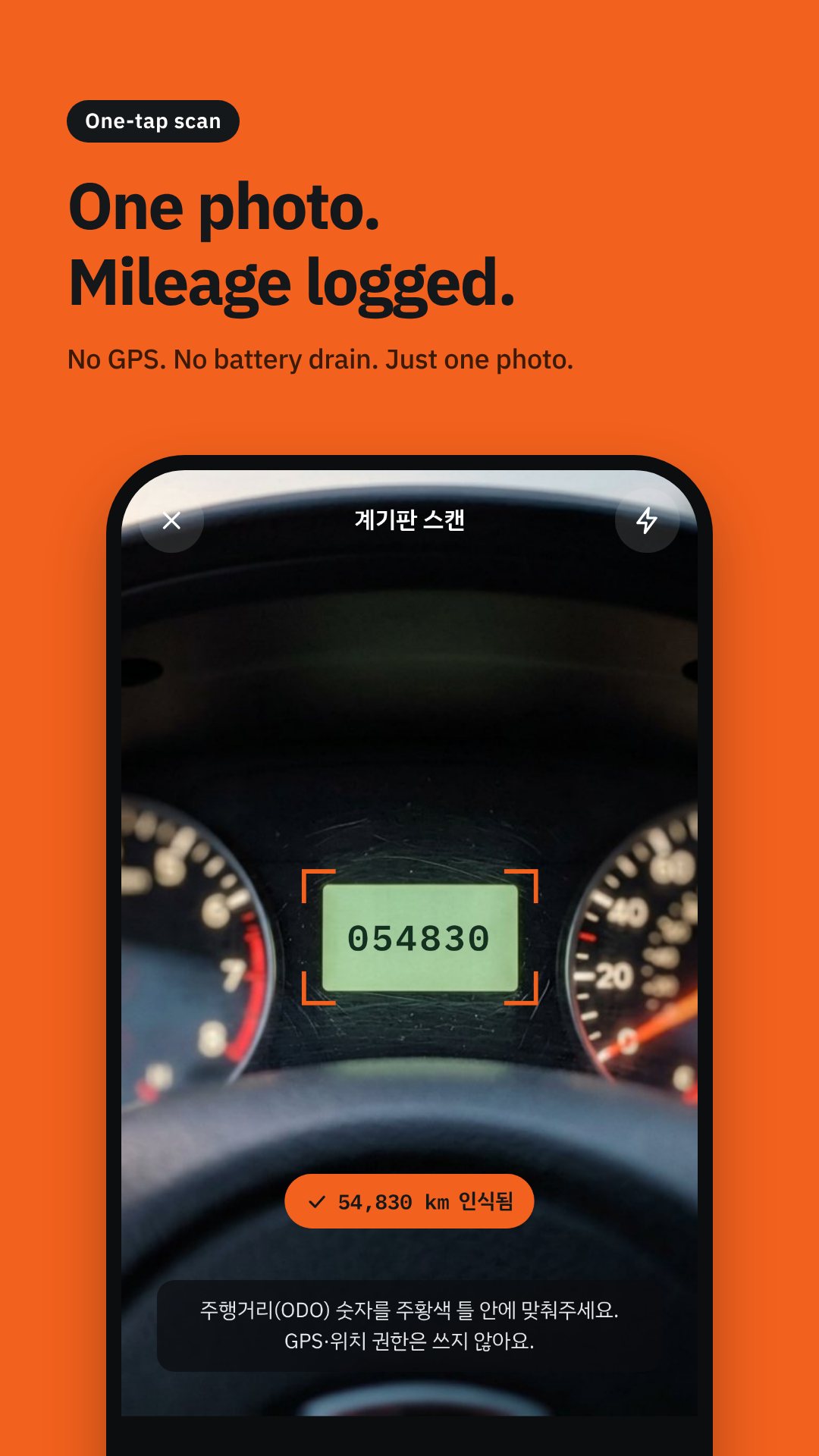
A dashboard photo is full of numbers that are not the odometer — the speedometer marks (20, 40 … 220), the clock at 08:12, the trip meter at 12.4, the coolant gauge. Kirosucon's parser throws those out on purpose: anything with a decimal point or a colon is rejected, and it quietly repairs the misreads OCR makes inside a run of digits — O becomes 0, I or l becomes 1, S becomes 5, B becomes 8. It keeps only 3-to-7-digit candidates, accepts a thousands comma like 54,830, and when it knows your last reading it picks the nearest value that is higher than before, within a sane 50,000 km jump. If every candidate is lower than last time, it stops and asks you to confirm instead of silently saving a wrong number. Text recognition is Google ML Kit running on the device, so nothing leaves the phone, and there is a manual keypad whenever a reading is dirty or the camera is not handy.
Know exactly where you stand on the refund
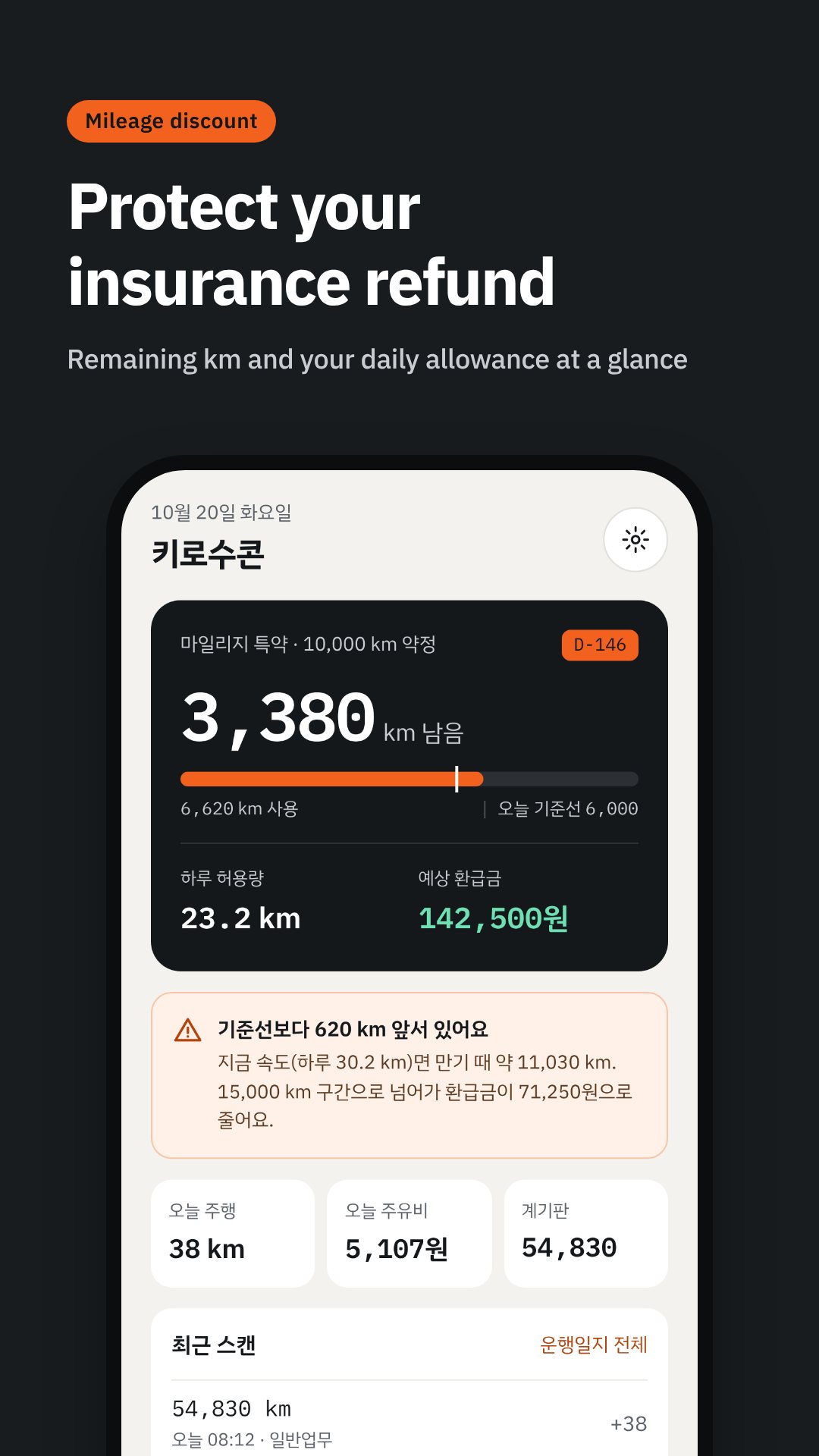
Set your policy start date, your premium and the mileage you contracted — Kirosucon offers the usual tiers of 3,000 / 5,000 / 10,000 / 15,000 km. The home screen then shows used and remaining distance, and a baseline: the kilometres you could have driven by today if you spread the contract evenly across the year. Drive less than the baseline and you are on track; more, and the app says you are ahead of pace. It projects your year-end distance from your current daily rate, tells you how many kilometres a day you have left, counts down the D-day to expiry, and estimates the refund for both your contract and your projected mileage. The rate table is an average of the published tiers from four big insurers — Samsung Fire, Hyundai, DB and KB — so every figure is clearly labelled an estimate, never a promise.
The tax logbook, exported in the official shape
Tag each drive as commute (출퇴근), business (일반업무) or personal (개인), and Kirosucon assembles the NTS 업무용승용차 운행기록부 for the tax year — the exact nine columns of the form, down to separate commute and general-business distance columns and the 업무사용비율 (business-use ratio) totalled at the bottom. Personal kilometres are excluded from that ratio, and the very first cumulative reading since your policy began is kept out of the logbook while still counting toward your insurance quota. Export it as an Excel (.xlsx) or PDF file and share it straight to your accountant.
Quietly useful extras
- Fuel-cost estimate — distance ÷ fuel economy (km/L) × price per litre, for petrol, diesel or LPG.
- Monthly bars — your driving across the policy year at a glance.
- Reminders — a daily "did you photograph the odometer?" nudge (9 pm by default), a baseline-exceeded warning, and an end-of-term reminder to submit your photo; they survive a reboot.
- Local backup — your readings export to a JSON file you control.
How to log a reading with Kirosucon
- In Settings, enter your insurer, policy start date, premium and contracted mileage.
- Tap the scan button and frame the odometer inside the bracket.
- Check the recognised number on the result screen, correcting it on the keypad if needed.
- Mark the drive as commute, business or personal, add a memo, and save.
- Open the tax logbook when you need it and export to Excel or PDF.
Good to know
OCR depends on your camera and the lighting on the cluster; a clean, straight shot reads best, and you can always type the number in. Refund percentages are estimates drawn from published insurer tiers, not a quote — confirm the figure with your own insurer. Kirosucon stores your driving records only on your device; the only network use is ads and the optional purchase to remove them.
Frequently asked questions
Does Kirosucon work offline?
Yes. The odometer OCR, the refund maths and the tax-logbook build all run on your device, and your records are saved only on the phone.
What permissions does it need?
Only the camera, for the odometer scan. There is no login, no phone number and no location (GPS) access.
Are the refund amounts official?
No. They are estimates averaged from the published tiers of four major insurers, and every screen that shows them says so — check your real figure with your insurer.
Can I export the National Tax Service driving logbook?
Yes. Kirosucon builds the 업무용승용차 운행기록부 in its official nine-column shape and exports it as an Excel or PDF file.