 By the NAXTECH team · Published 25 Oct 2026 · Updated 11 Nov 2026 · Hands-on with v1.0

You have been meaning to open a savings account, book the haircut and sign the lease — but your grandmother would have asked one question first: is it a good day for it? The paper Tong Shu that answered that question is dense, printed once a year, and easy to misread. Tong Shu Almanac puts the same reasoning in your pocket and does the lookup for you.
The app opens on today: the ruling Day Officer, a plain-language verdict, and a wealth score out of 100 for the day. Tap back and forth through the days, and everything — the day pillar, the solar month, the officer, the clash — is calculated on your device by the app's own almanac engine, so a reading at the bank counter never waits for a signal.
The heart of the almanac is the cycle of 12 Day Officers (建除十二神) — Jian, Chu, Man, Ping, Ding, Zhi, Po, Wei, Cheng, Shou, Kai and Bi. Tong Shu Almanac names today's officer, shows its Chinese character on a carved seal, and turns it into a status you can read at a glance, from excellent down to danger. A Cheng (成) day scores near the top; a Po (破) or Bi (閉) day is flagged as one to be careful with. A built-in guide explains what each of the twelve officers favours and what it rules out.
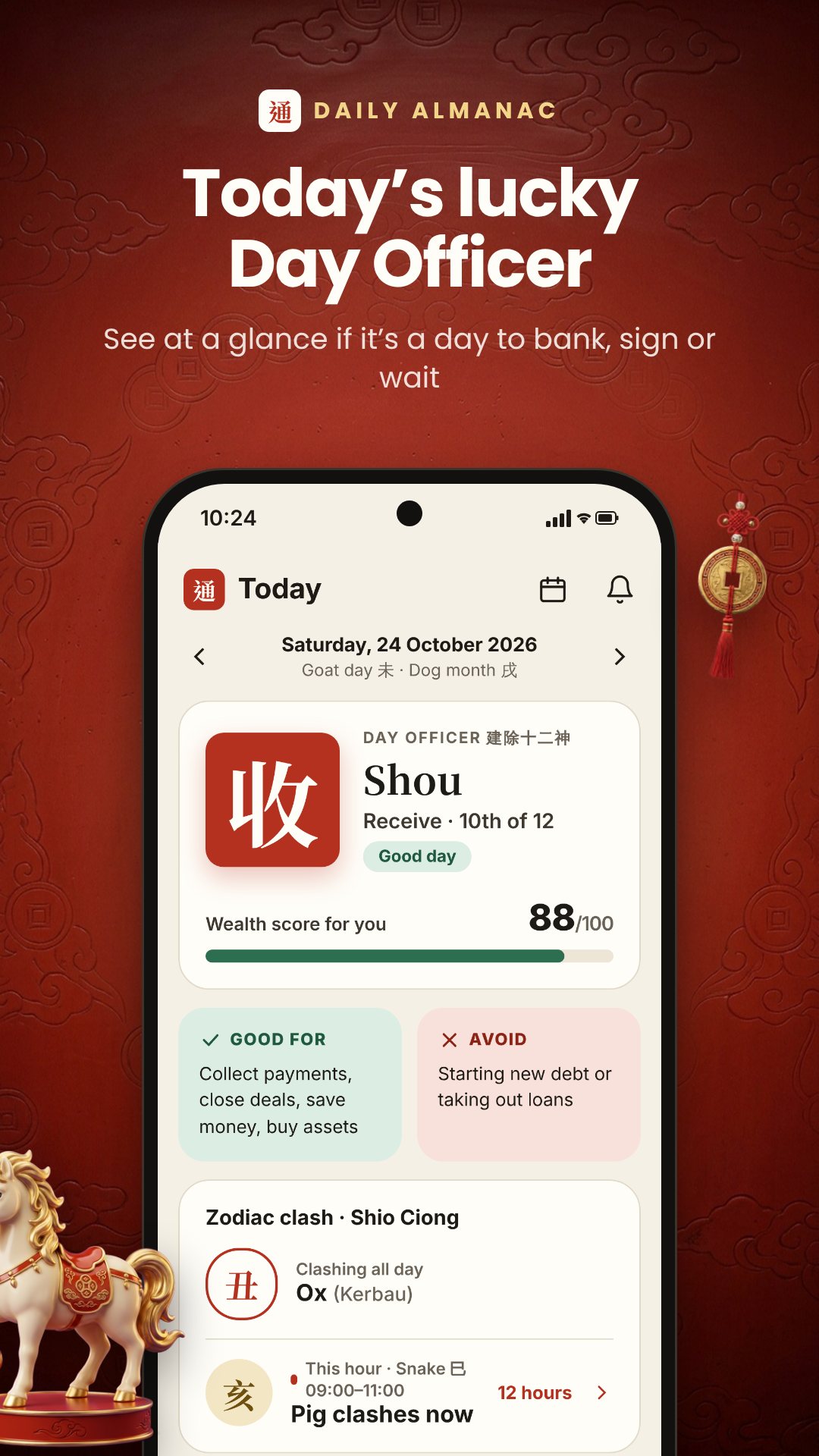
Instead of leaving you to interpret the officer yourself, the calendar scores ten real activities — haircut, bank deposit, cutting nails, signing a contract, a grand opening, moving house, a wedding, travel, medical treatment and burial. Pick one and the month lights up with best, good, neutral and avoid days. Open any day for the full reading: what to do, what to strictly avoid, and the clashing zodiac sign for that day.
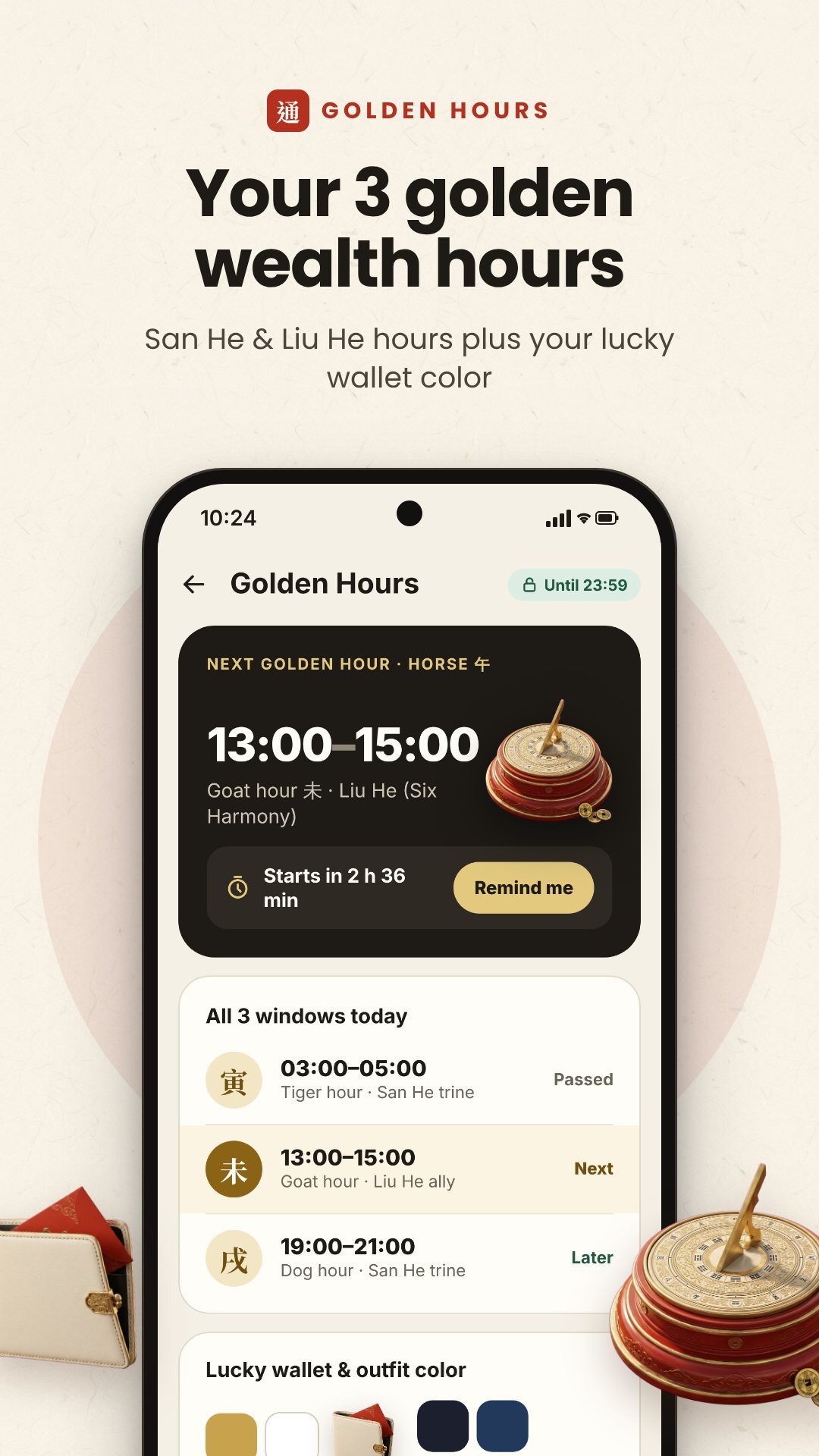
Days have good hours too. From your zodiac sign the app works out your golden wealth hours — three windows built from the San He and Liu He relationships of your sign — and lays the day out as the traditional 12 double-hours (時辰), each with its hourly Shio clash. It even names your wealth element and the element to avoid, so the lucky colours follow from your own chart rather than a generic list.
Tong Shu Almanac follows the almanac convention that the zodiac year turns at Lichun (立春, around 4 February), and its solar months begin on the twelve "jie" solar terms. It presents traditional Chinese metaphysics for cultural, educational and reference use and does not replace professional advice on health, legal, financial or other matters. The app is free with ads and offers an optional Premium upgrade that removes them and unlocks the golden hours.
Yes. The Day Officer, wealth score, golden hours and every calendar reading are computed on your device, so you need no connection and no account.
You set your birth year once; the app finds your Chinese zodiac sign and uses it for clashes, golden hours and compatibility, so a day that clashes with your animal is marked down for you.
Ten: haircut, bank deposit, cutting nails, contracts, a grand opening, moving house, weddings, travel, medical treatment and burial.
Yes, it is free to download with ads, with an optional Premium upgrade that removes ads and unlocks the golden wealth hours.
Get Tong Shu Almanac on Google Play →
 By the NAXTECH team · Published 24 Aug 2026 · Updated 9 Oct 2026 · Hands-on with v1.0
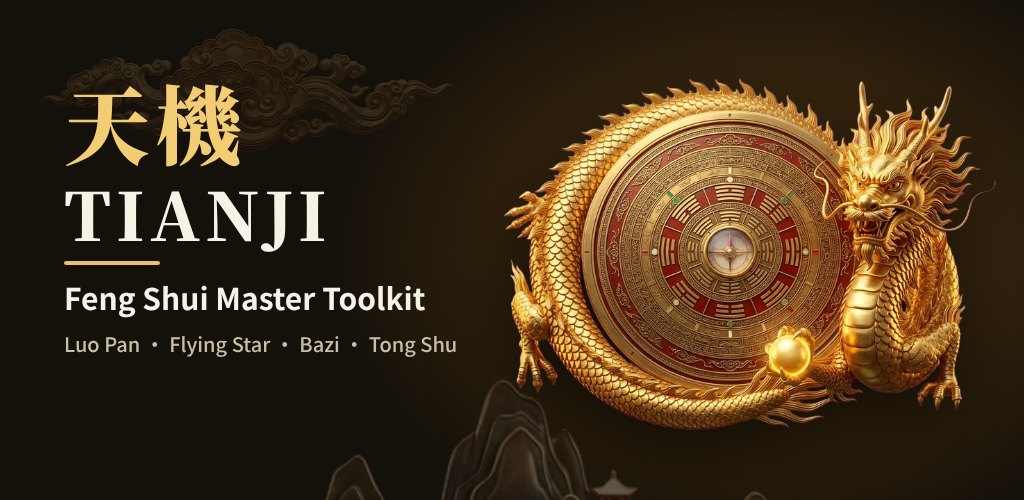
You are standing at a client's front door, phone in hand, trying to read the facing of the house — and the plain compass app swings around like it has never heard of a Luo Pan. For anyone who practises feng shui, that gap between a toy digital compass and a real master's plate is the whole problem. TianJi 天機 was built to close it.
TianJi is a feng shui app built around a traditional Luo Pan compass, bundled with the classical calculation systems a practitioner actually reaches for — Xuan Kong Flying Stars, BaZi Four Pillars, Ba Zhai Eight Mansions and the Tong Shu almanac — each one tap away. The core calculations run on your device, so a reading at a doorway never stalls waiting for a signal.
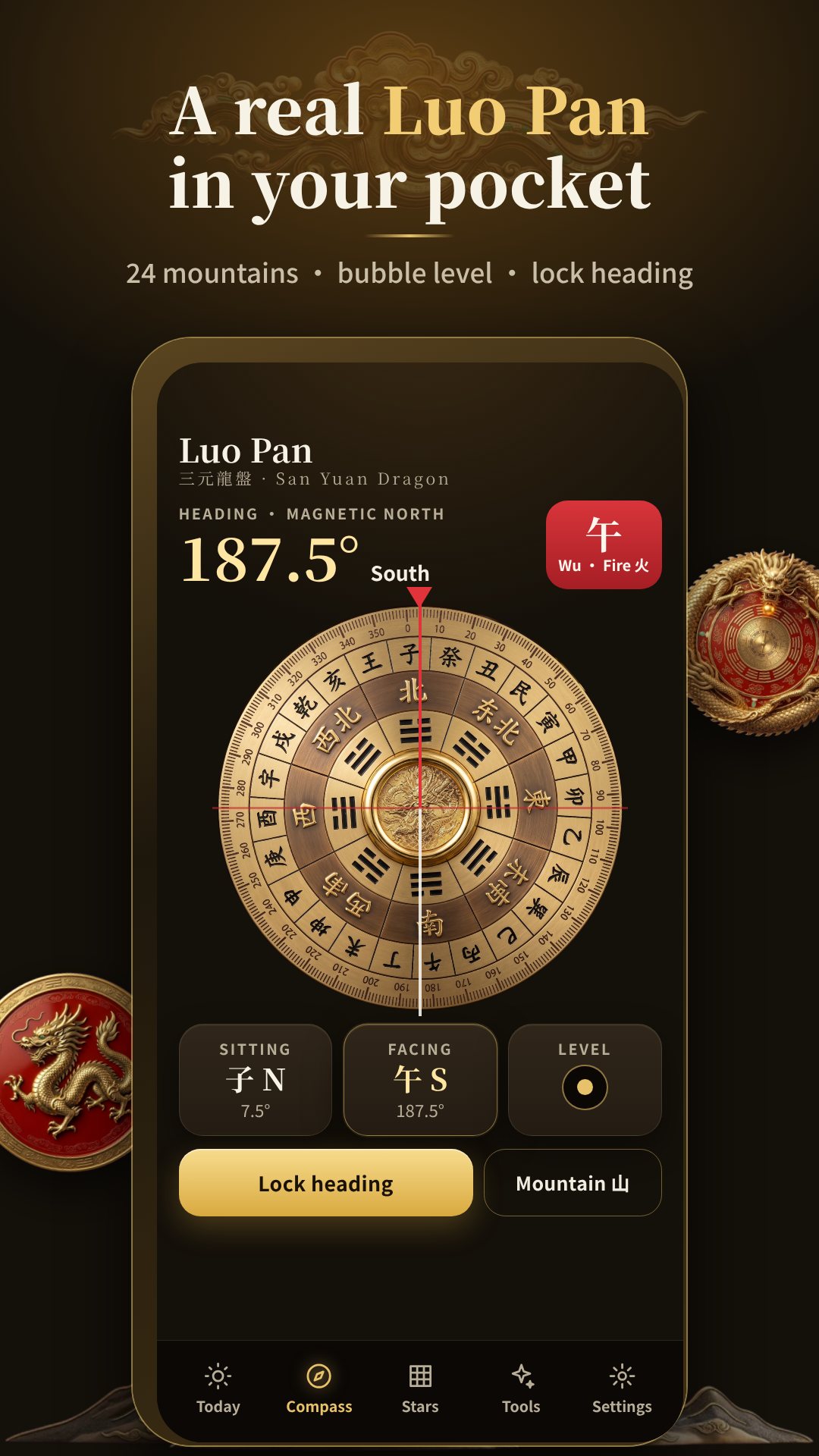
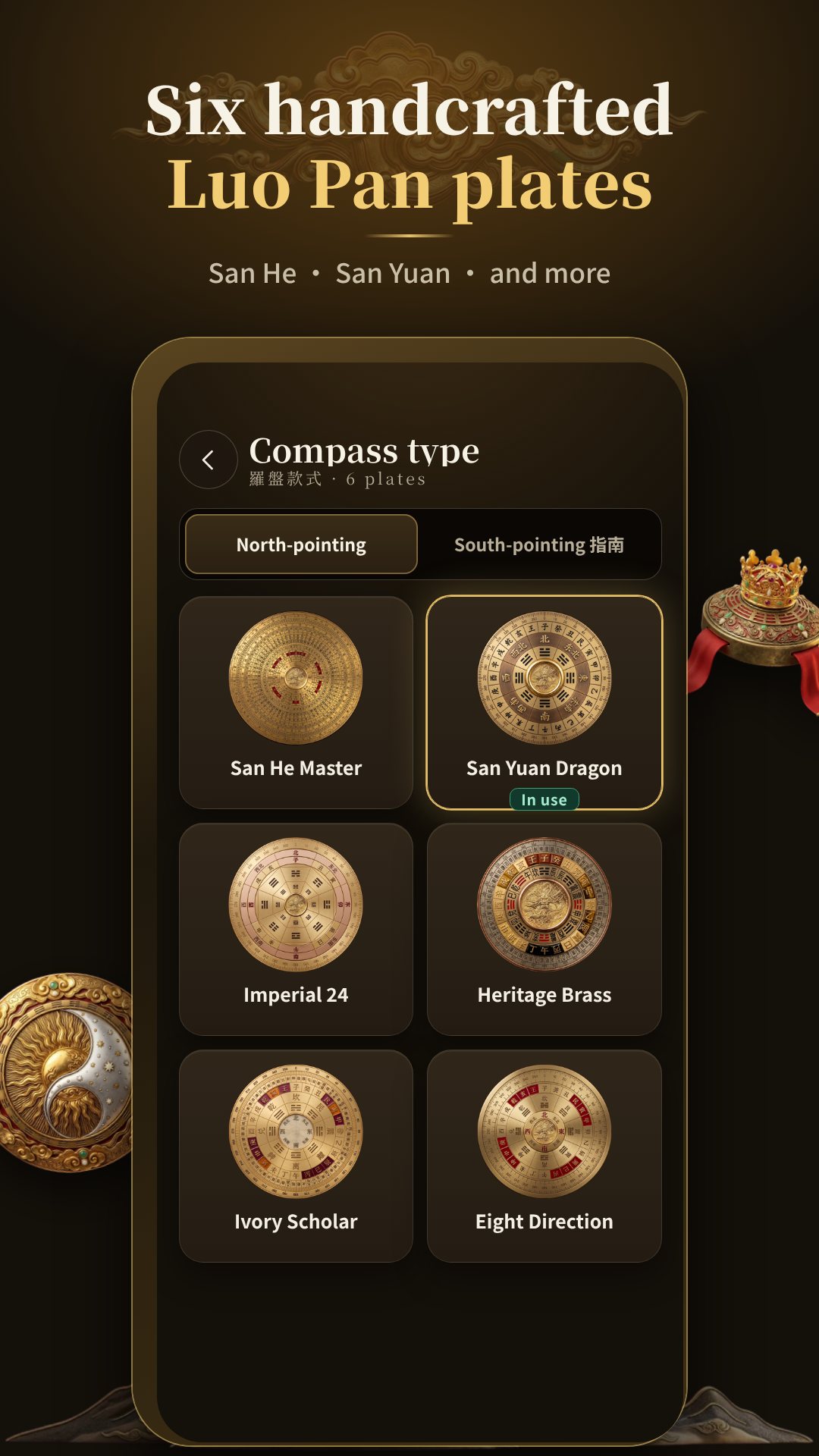
The compass is the heart of the app, not a gimmick bolted on. TianJi ships six detailed Luo Pan plates you can switch between, and overlays the 24 Mountains (二十四山) — each a precise 15° sector — with its trigram, five-element association and yin/yang polarity. You can choose a north-pointing or a south-pointing needle (the 指南針 convention) the way you were taught, turn on True North correction, and pinch to zoom deep into the rings. A bubble level keeps the phone flat, and a single tap on Lock Heading freezes the facing degree so you can read the plate without the needle drifting. A light haptic tick marks the eight directions as you turn.
The Xuan Kong Flying Star (玄空飛星) module builds annual (年紫白), monthly (月紫白) and daily (日紫白) nine-palace charts. It is Period 9 aware and works the 20-year periods and 180-year cycles back to 1864, when Period 1 began. Because different lineages disagree on when the astrological year turns over, TianJi lets you set the year boundary yourself — Li Chun (solar 立春), Lunar New Year, or Gregorian 1 January — so the charts match the system you follow.
TianJi keeps the Chinese term beside each English label — 二十四山, 玄空飛星, 八字 — so a student picks up the vocabulary while a working practitioner moves quickly. You can set your needle convention, True North correction, haptics and year boundary once in Settings, and the interface follows you in English, Thai or Chinese.
Compass readings depend on your phone's magnetometer, so calibrate with a figure-8 motion and keep clear of metal railings, rebar and magnets. TianJi presents traditional Chinese metaphysics for cultural, educational and reference use; it is not a substitute for professional advice on health, legal, financial or construction matters. The app is free, contains ads, and offers optional in-app purchases.
No. The Luo Pan, Flying Star, BaZi, Ba Zhai and Tong Shu calculations run on your device, so you can take a reading at a doorway with no signal.
Your choice — Li Chun (solar), Lunar New Year or Gregorian 1 January — so the charts match the lineage you practise.
Yes. Each tool shows the Chinese term beside its translation, and the calculators are organised so a student can study the system while a practitioner works fast.
Yes, it is free to download with ads, and it offers optional in-app purchases.