 By the NAXTECH team · Published 29 May 2026 · Updated 25 Sept 2026 · Hands-on with v1.0

It is 7am, you are half-dressed in front of the wardrobe, and the question is the same as every morning: what colour today? Maybe you were told to avoid your กาลกิณี colour, or that your Saju needs water this week — three traditions, three different answers. Lucky Shade settles it in one tap by actually doing the chart maths instead of guessing.
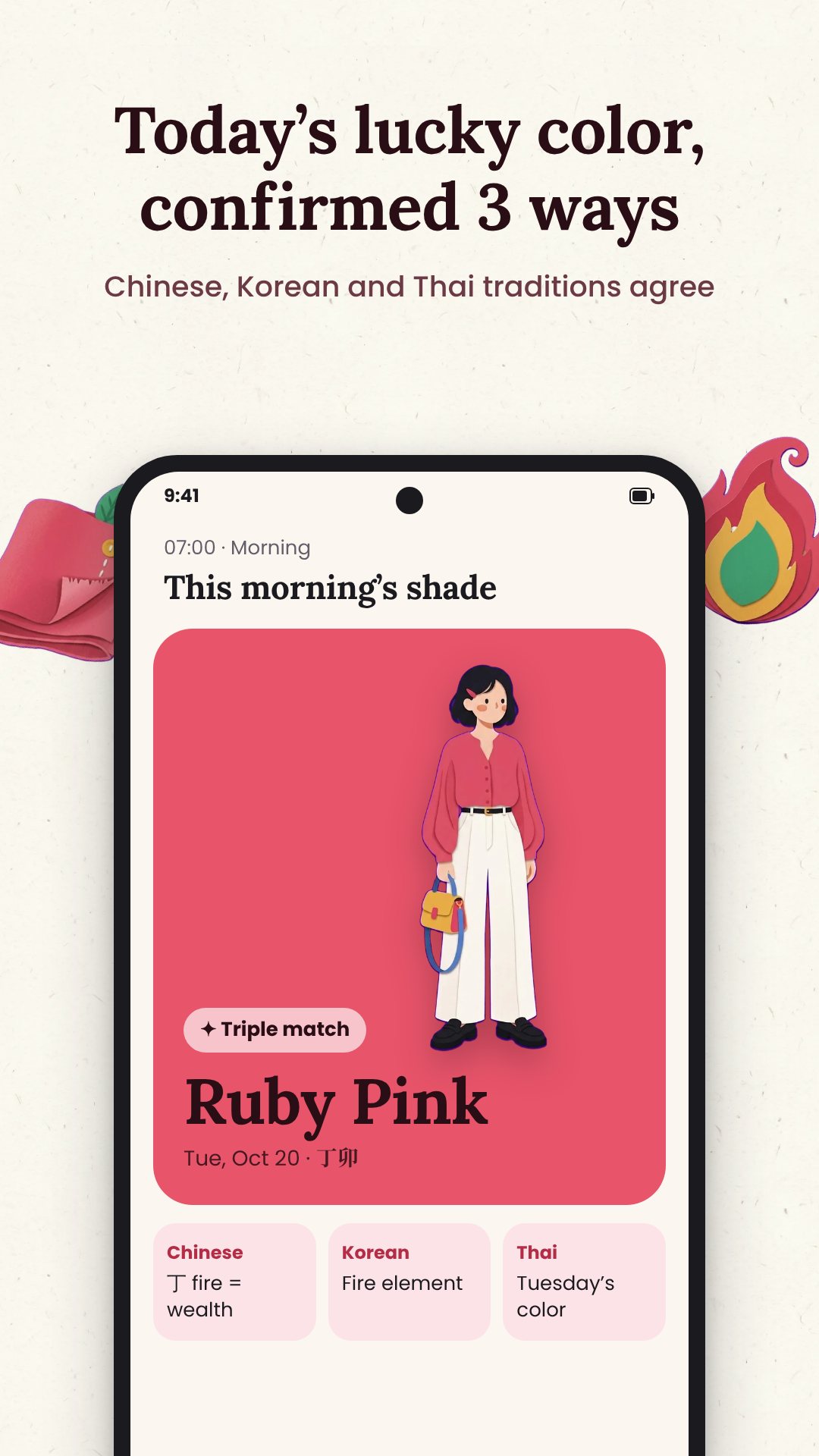
Lucky Shade reads your birth date and time once, builds your Four Pillars chart, and then each morning blends three traditions — Chinese, Korean and Thai — into a single lucky colour, a wealth direction and a matching money wallpaper. Everything is calculated on your device from a built-in astronomical engine, so it works on a plane, in a tunnel, anywhere.
Most lucky-colour apps pick a shade at random. Lucky Shade does the work a fortune-teller would. The Chinese colour comes from today's day-stem element measured against your wealth, resource and output stars; the Korean colour checks for a 天干合 bond with your day master; the Thai colour is your weekday colour unless it happens to be your unlucky กาลกิณี shade, in which case it swaps to your auspicious ศรี colour. The app then takes the majority — and when all three systems land on the same element, you get a rare "triple" day. Every colour maps to one of five element accents (jade, ruby, ochre, gold and indigo) that re-tint the whole app.
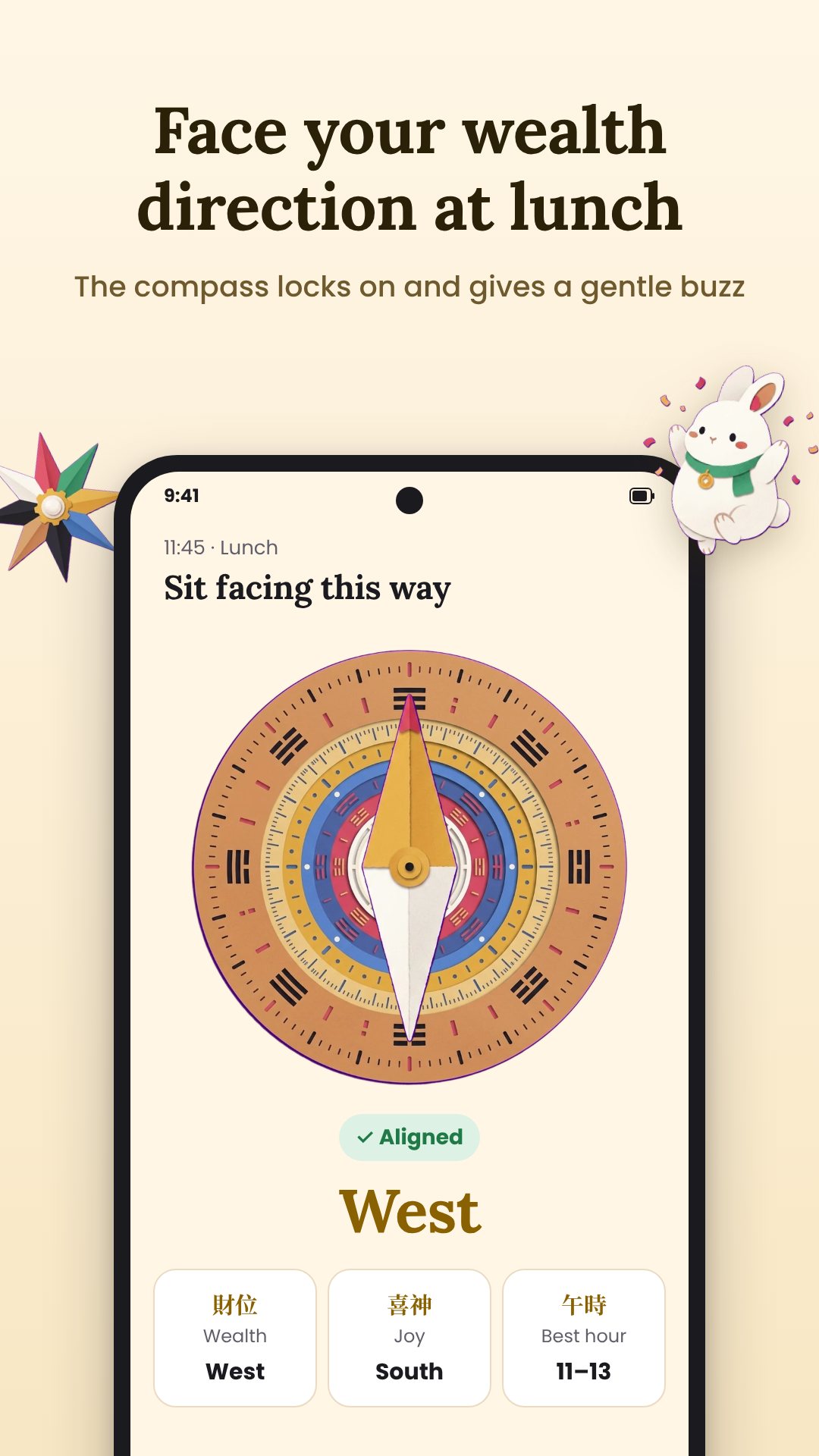
Alongside the colour, Lucky Shade gives you a wealth direction drawn from your personal Eight Mansions (八宅) chart — your 生氣 sheng chi direction, unless that clashes with today's 煞 star, in which case it steps to 延年. The Today screen pairs it with four at-a-glance scores for money, work, love and health, so the day's reading is a single card, not a wall of jargon.
Each time of day has its own theme, so the app literally changes shade as the hours pass, and a streak and a set of 12 zodiac stickers reward you for showing up.
There is no login and no cloud. Your birth details and journal stay on the phone, and you can make an encrypted backup file to move them yourself. The camera is used only for the wardrobe scan and is optional; the compass uses your phone's magnetometer. Premium adds a live wallpaper that swaps the lucky colour at each two-hour 時辰 boundary.
Lucky Shade presents Chinese, Korean and Thai fortune traditions for cultural, educational and entertainment use; it is not a substitute for professional advice. The app is free with ads, and an optional subscription unlocks premium extras.
Yes. The Four Pillars chart, the daily colour and the wealth direction are all calculated on your device, with no account and no connection needed.
It works out the Chinese, Korean and Thai colour for the day and takes the majority element, marking a "triple" day when all three agree.
You photograph a garment and the app reads its dominant colour, sorts it into one of the five elements, and suggests outfits that match today's colour roles.
Yes, it is free to download with ads, and offers an optional premium subscription that adds the live colour-changing wallpaper.
Get Lucky Shade on Google Play →
 By the NAXTECH team · Published 30 Mar 2026 · Updated 10 Jun 2026 · Hands-on with v1.0

You are about to send the transfer, sign the deal, or buy the lottery ticket — and a quiet voice asks: is this a good hour for money, or am I walking into a loss? Traditional Korean Saju has an answer, but it normally lives in a fortune-teller's thick Manseryeok almanac, not in your pocket. Pyeonjae Manseryeok (편재 만세력) was built to put that answer one glance away. It reads your birth chart's day master and, for the current two-hour period, works out which of the ten Saju "gods" (십성, the Ten Gods) is in play — and whether it is a wealth hour or a loss hour. Everything is calculated on your device, so a reading at the bank counter never waits for a signal.
The home screen is a live radar that refreshes through the day. It names the Ten God forming between your day master and the current period's stem, shows its relationship to you — I control it, it controls me, we share energy — and scores the hour. The star of the app is Pyeonjae (편재, Indirect Wealth), scored 98: the windfall, investment and lottery-luck hour. Its mirror is Geopjae (겁재, Rob Wealth), scored 10, which flips the screen into a red "money-loss alert" telling you to close your wallet.
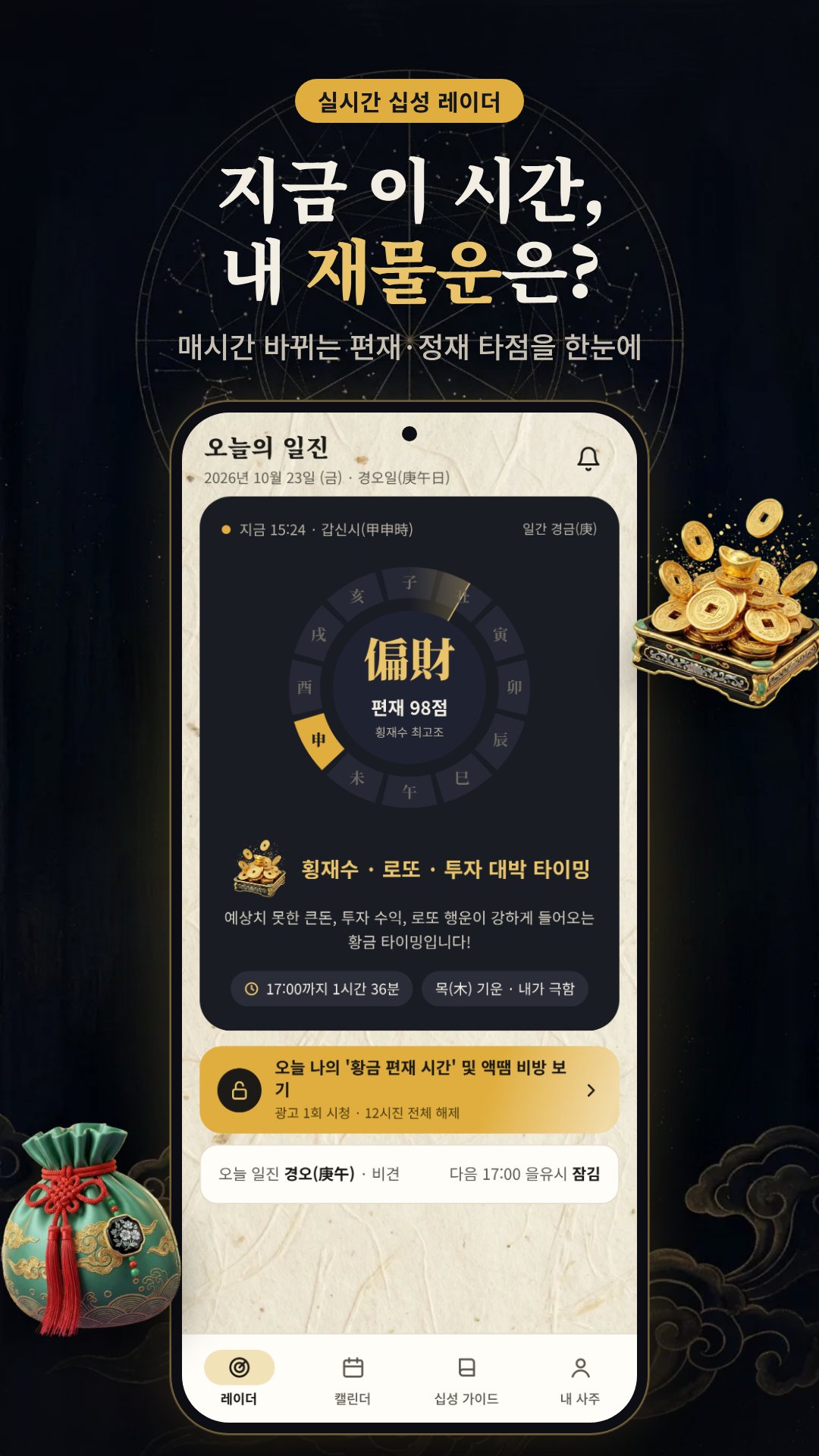
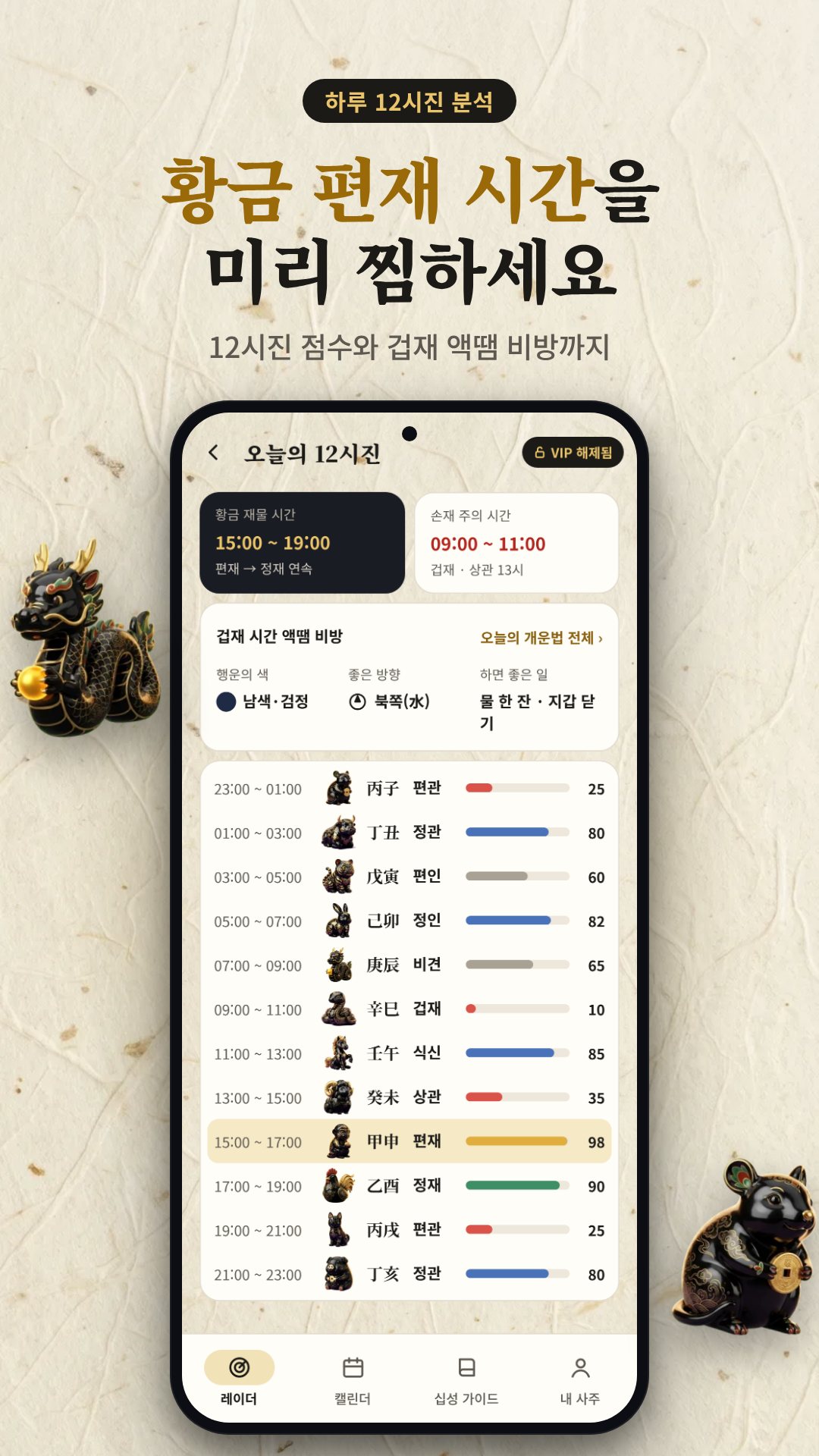
Saju divides the day into twelve two-hour periods (시진), starting at the Rat hour at 23:00. Pyeonjae Manseryeok lays all twelve out with their pillar, their Ten God and a score, then finds your golden wealth window — a run of consecutive Pyeonjae or Jeongjae (Direct Wealth) hours — and flags the Geopjae hours to avoid. It is the difference between knowing today is lucky and knowing that 13:00 to 15:00 is the hour to act.
The Luck Remedies screen reads the element your day master "controls" — your wealth element — and turns it into practical cues: the lucky colours to wear, a compass direction to sit facing, two lucky numbers and small actions for the day, plus a second element that guards against loss on Geopjae hours. Nothing here is generic horoscope filler; each suggestion is derived from the Five Elements of your own pillars.
Behind the daily radar is a real offline engine. The Full Saju Chart builds your Four Pillars — year, month, day and hour — using astronomical solar-term boundaries rather than a rough lookup, shows the Five-Element balance of all eight characters, and names your day master. Birth dates can be solar or lunar (leap months included), with times handled as Korean Standard Time. A Wealth Compatibility tool compares your day pillar with people you save, and a Ten Gods Guide explains all ten gods, what each favours and what to avoid.
You do not have to keep opening the app. A home-screen widget shows the current god and hour, and up to three daily notifications nudge you — a morning read of the day's energy, a heads-up about ten minutes before your first wealth hour, and a Geopjae loss alert — so a golden window never slips past while you are busy.
Pyeonjae Manseryeok presents traditional Korean Saju for cultural and entertainment use; it is not financial advice, and words like lottery or investment describe fortune concepts, not recommendations. The app works fully offline and keeps your birth data on the device; it is free with ads, with an optional VIP unlock that opens the premium hours and views for the day.
Yes. The day and hour pillars, the solar-term chart and every Ten-God reading run on your device, so you can check an hour with no connection.
They are the two-hour periods when your day master forms Pyeonjae or Jeongjae — the wealth gods — shown as a highlighted window among the day's twelve periods.
Yes. You can choose a solar or lunar birth date, including leap months, and birth times are treated as Korean Standard Time.
No. It is a traditional Saju almanac for cultural and entertainment use, not advice on money, stocks or lotteries.