 By the NAXTECH team · Published 24 Feb 2026 · Updated 30 Jul 2026 · Hands-on with v2.0
You have taken one of those "which character are you" quizzes, got a four-letter badge, and quietly suspected it was made up. Most free personality tests are. Big Five was built for the opposite feeling: a result you can actually trust, grounded in the model psychologists themselves use — the Five-Factor Model, better known by its initials, OCEAN.
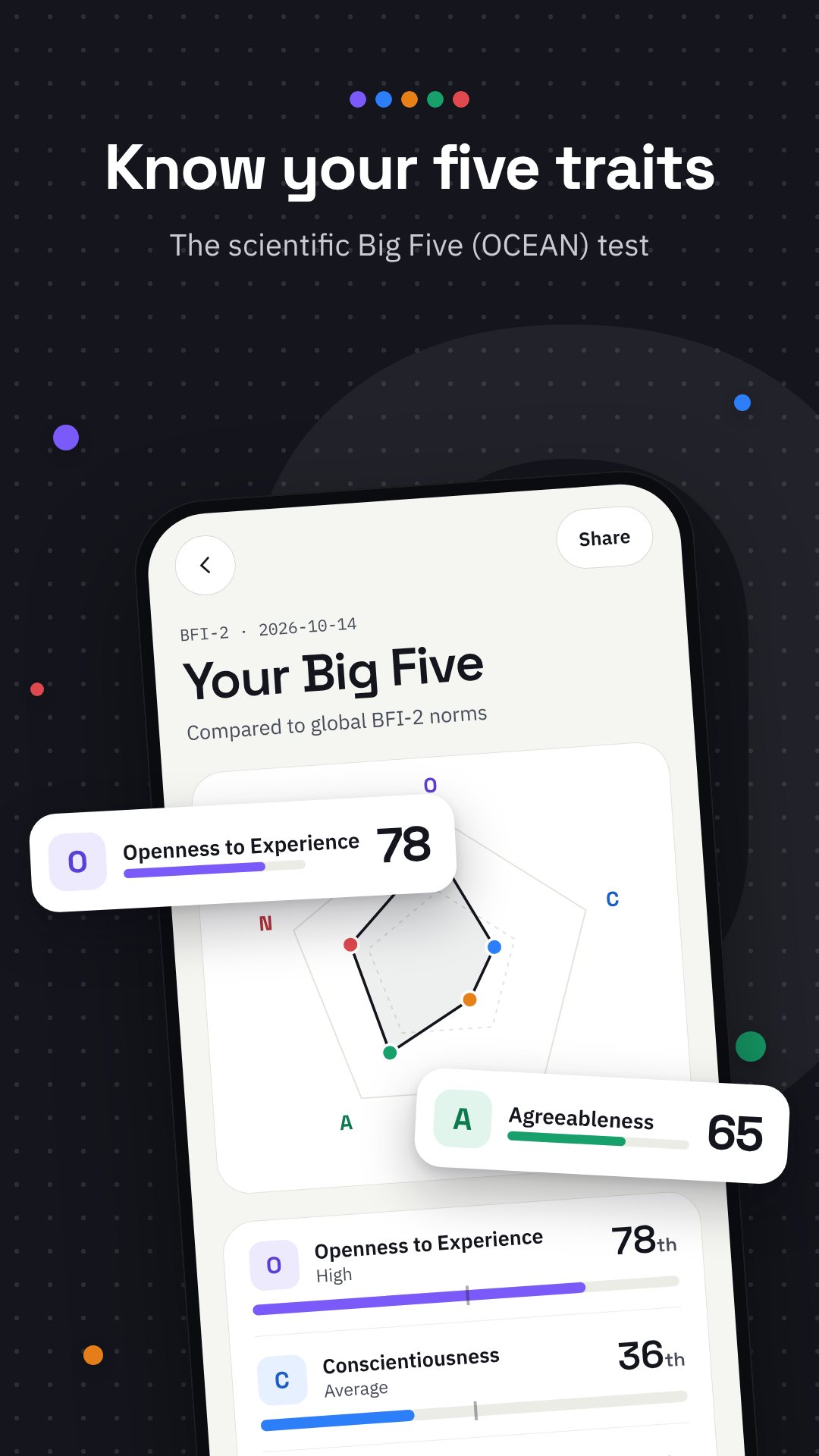
Instead of sorting you into a type, Big Five measures five independent traits — Openness, Conscientiousness, Extraversion, Agreeableness and Neuroticism — and shows where you land on each as a percentile against the general population. Everything is scored on your device, with no account and no sign-up, so a private self-assessment stays private.
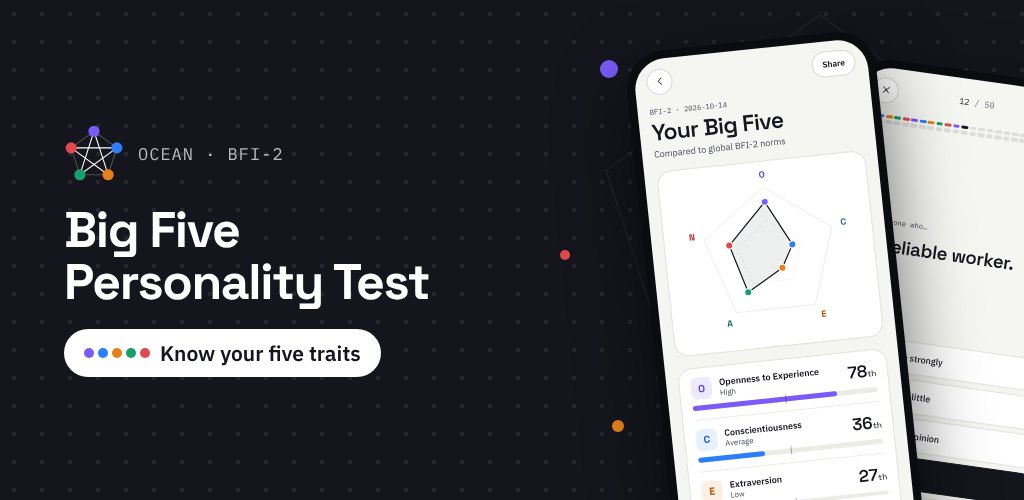
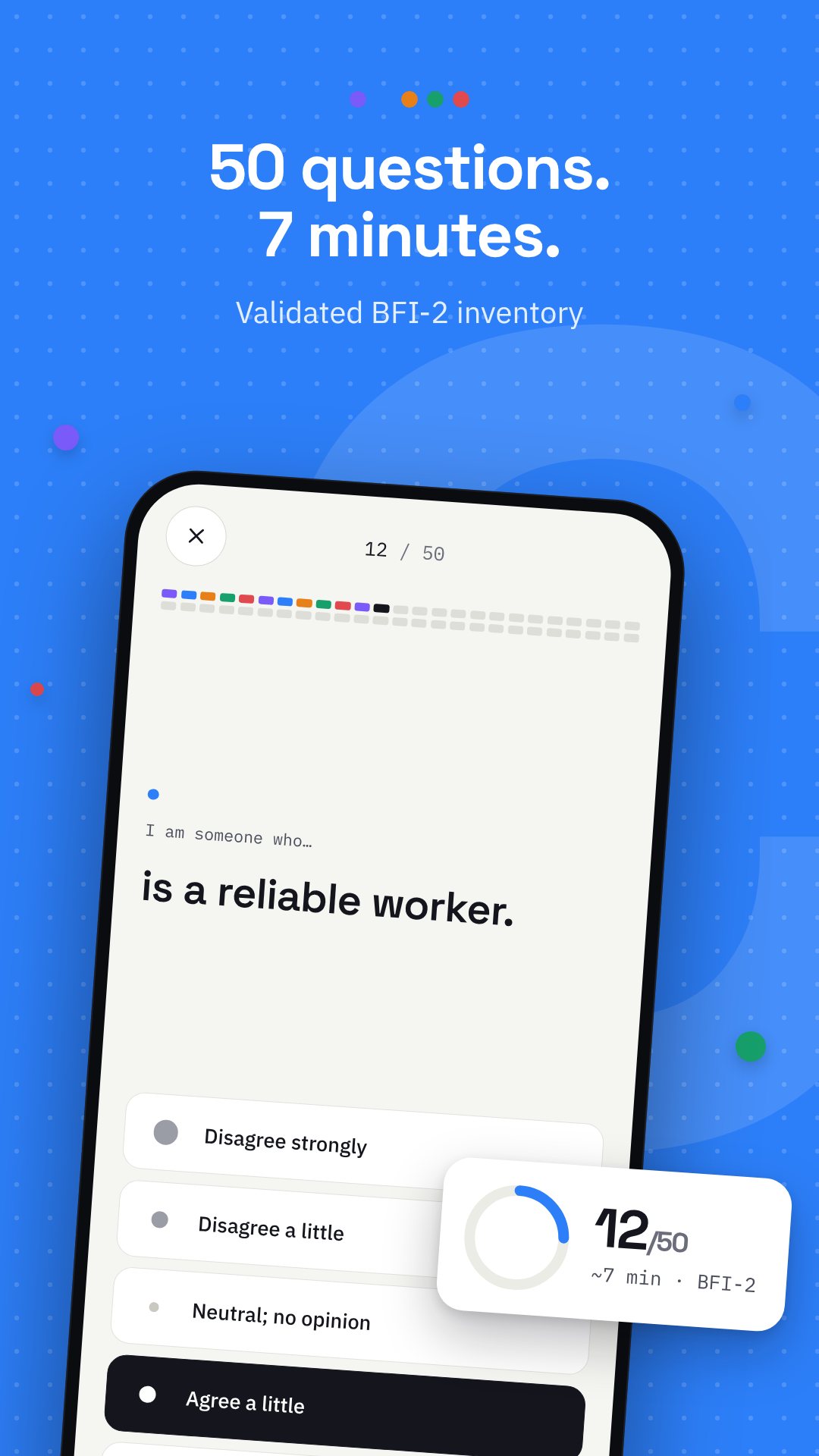
The core assessment is the 50-item Big Five Inventory-2 (BFI-2), a published, validated questionnaire rather than a novelty quiz. You rate each statement on a five-point scale — from Disagree strongly to Agree strongly — and it takes only a few minutes. The app handles the fiddly parts for you: reverse-scored items are flipped automatically, each trait is averaged, and your raw score is converted into a percentile using BFI-2 population norms. The result is a radar chart that reveals all five traits at once, with a plain-language high or low write-up for every one.
When five traits are not enough, the optional Pro test runs 120 items and breaks each trait into six facets — 30 in total. Openness, for example, splits into Imagination, Artistic Interests, Emotionality, Adventurousness, Intellect and Liberalism, so you can see that two people with the same Openness score can be open in completely different ways. The Pro result keeps the same percentile approach at both the trait and facet level, giving you a far more detailed map of your personality in one sitting.
The Career Compass takes your OCEAN result and ranks 40 occupations — from Software Engineer and Data Scientist to UX Designer, Registered Nurse and Physical Therapist — by how closely their typical personality profile sits to yours. It is a conversation starter for anyone weighing a direction, not a verdict, and it reads directly from the test you just took.
Curious how you line up with a friend? Big Five turns your five percentiles into a short offline code (and a matching QR code) that encodes only those numbers plus a checksum. Your friend scans it with the camera or types it in, and the app shows a side-by-side comparison — all on device, with nothing uploaded to a server. The camera permission exists purely to scan that QR code.
Every result can be exported as a polished 1080×1920 "My Big Five" story card straight to the share sheet, and the app saves past results so you can retake the test later and watch your profile shift over time.
Big Five is a tool for self-discovery, reflection and curiosity — it is not a clinical or diagnostic instrument and does not replace professional advice. Percentiles compare you to general-population norms, so they describe tendencies, not fixed labels. The app is free with ads, processes your answers on device, and offers an optional in-app purchase to unlock the Pro test.
Yes. It uses the 50-item Big Five Inventory-2 (BFI-2), a validated questionnaire built on the widely studied Five-Factor (OCEAN) model, and reports your results as percentiles against population norms.
It works fully offline and needs no account. Your answers are scored on your device, and nothing is uploaded to a server.
The free test is 50 items and scores the five traits; the optional 120-item Pro test adds 30 facets, six per trait, for a more detailed profile.
Your five percentiles become a short code and QR that a friend scans or types in. Only those numbers are shared, entirely on device.