 By the NAXTECH team · Published 15 Aug 2026 · Updated 14 Oct 2026 · Hands-on with v1.0
You have a real decision in front of you — sign the contract this week, hold the position, take the new role — and the advice you can find is either a fortune-cookie line or a wall of untranslated classical Chinese. The I Ching has guided that kind of choice for three thousand years, but most phone apps turn it into a single vague sentence. I Ching Coin Oracle was built to give you the actual reading: the hexagram, the lines that are moving, and where they lead.
It is an I Ching oracle centred on the classical three-coin method. You hold one clear question, toss three coins six times, and the app builds your hexagram line by line from the bottom up — exactly as it is done with real coins, but with the maths, the lunar date and the full texts handled for you. Everything runs on the device, so a reading never waits for a signal.
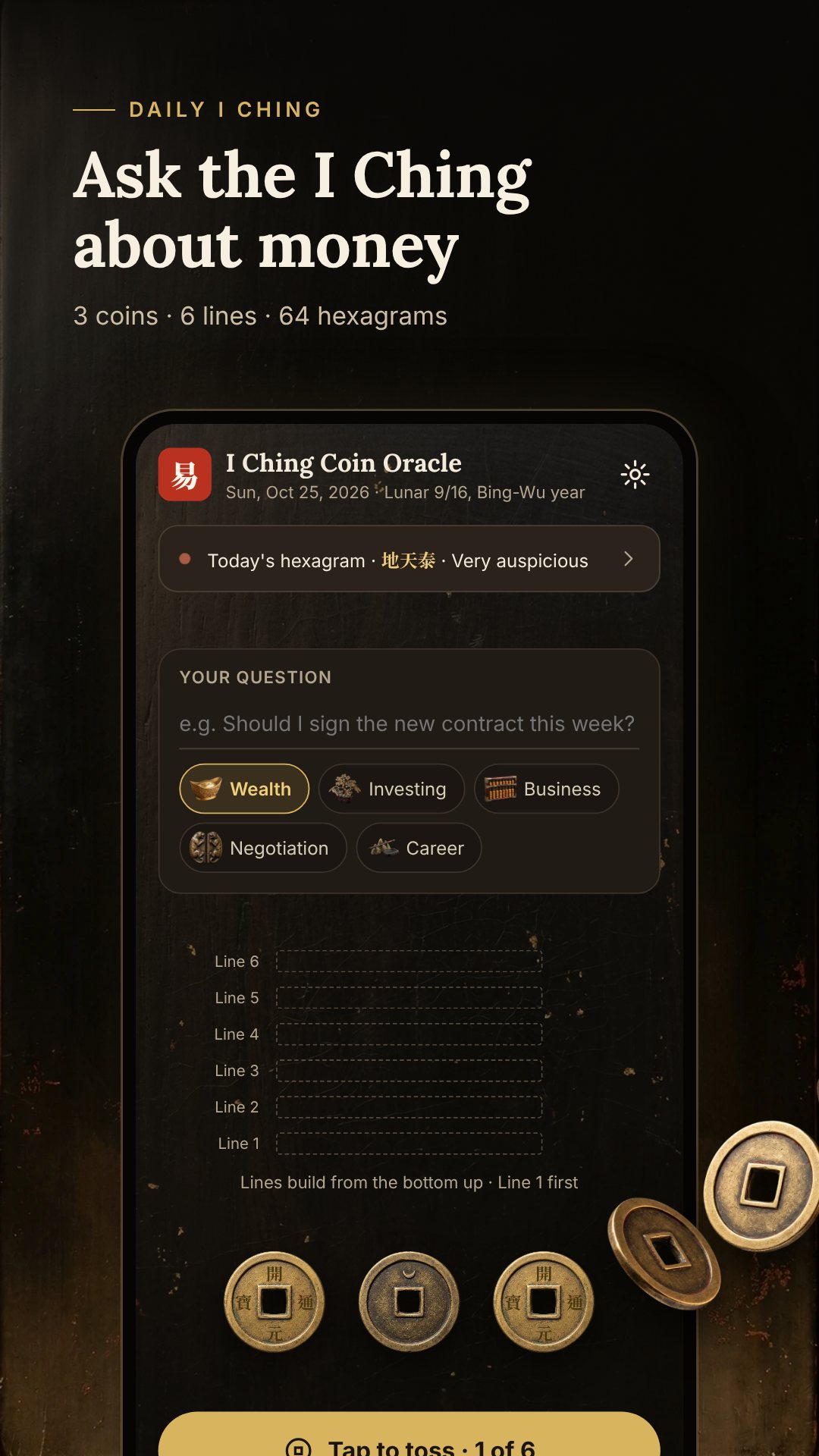
Each of the six tosses reads three coins and scores them the traditional way, giving one of four line values — 6 old yin, 7 young yang, 8 young yin or 9 old yang — so that old yin and old yang mark the changing lines. The lines stack from line 1 upward until your primary hexagram is complete. You can tap to toss, or turn on shake-to-toss and let the phone's motion sensor cast the coins, with a coin-drop sound and haptic feedback for each landing. Before you begin you set a focus for the question — Wealth, Investing, Business, Negotiation or Career — so the guidance speaks to money and work rather than generic fate.
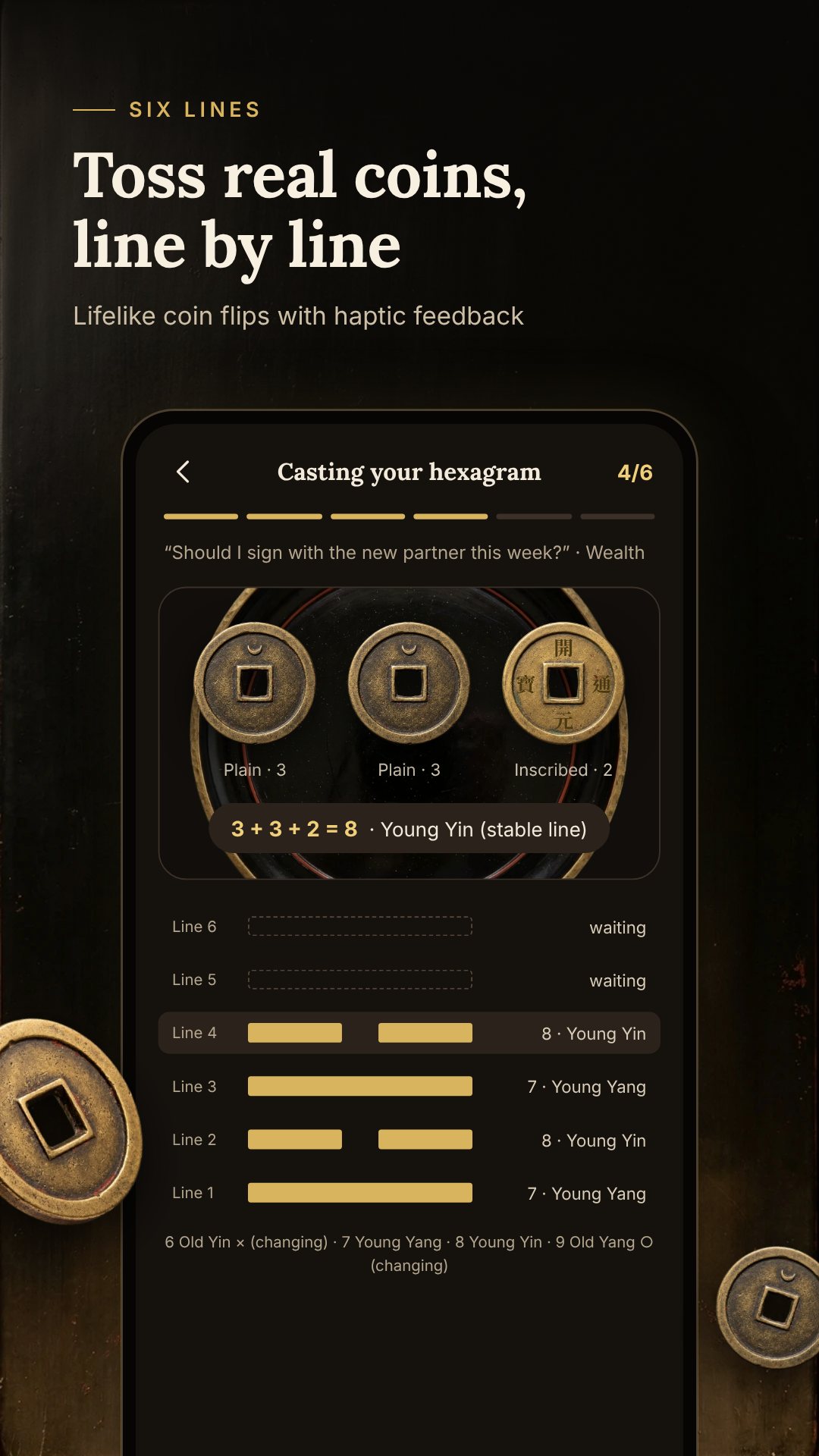
A reading is more than one picture. The oracle shows your primary hexagram, then flips the changing lines to reveal the changing hexagram — the situation it is moving toward — along with the specific line texts that are in motion. When no line changes, the situation is settled, and the app points you to the nuclear hexagram (built from the inner lines) for the hidden factor at work. Every hexagram carries a wealth outlook from unfavourable to very auspicious, so you can read the direction of a change at a glance.
Sometimes you want an answer on the spot. The Plum Blossom (Mai Hoa Dịch Số) method casts a hexagram without coins: by the current time, by a date and hour you pick, or from two numbers you choose. It combines the year branch, lunar month and day into the upper trigram, then the hour branch into the lower trigram and the moving line — the same numerology a Plum Blossom practitioner uses — and hands you a full reading in a tap.
Open the app for today's hexagram in three slots — morning, noon and evening — and keep a daily streak going, with optional reminders at 07:00, 12:00 and 20:00. For study there is a complete library of all 64 hexagrams, browsable as an 8×8 grid of upper and lower trigrams or as a King Wen list, each with its classical judgment, six line texts, Chinese name and pinyin. A separate section lays out the eight trigrams with their element, family role, direction and Early Heaven number.
Every cast is saved to a private journal you can filter by method or by the readings you have starred, and swipe to clear. When a hexagram feels worth keeping, turn it into a 9:16 share card rendered as an image and send it through your phone's share sheet. Nothing leaves your device unless you choose to share it.
I Ching Coin Oracle presents the classical Zhou Yi (Wang Bi lineage) for cultural, educational and reflective use; it is a tool for thinking a decision through, not a substitute for professional financial, legal or medical advice. The core — tossing, the 64 hexagrams, Plum Blossom and your journal — runs offline with no account. The app is free and contains ads, with an optional one-time purchase to remove them and unlock everything.
Yes. The coin toss, Plum Blossom casting, the 64-hexagram library and your journal all run on the device, so you can cast a reading with no connection.
No. The app tosses three virtual coins for you — by tap or by shaking the phone — and you can also cast by time or by two numbers with the Plum Blossom method.
Lines that come up as old yin (6) or old yang (9) are moving, and the app flips them to show the changing hexagram — the situation your reading is heading toward.
Yes, it is free to download with ads, and offers an optional one-time purchase to remove ads and unlock the full changing-line guidance, journal and sharing.
Get I Ching Coin Oracle on Google Play →
 By the NAXTECH team · Published 16 Jan 2026 · Updated 21 Jul 2026 · Hands-on with v1.0
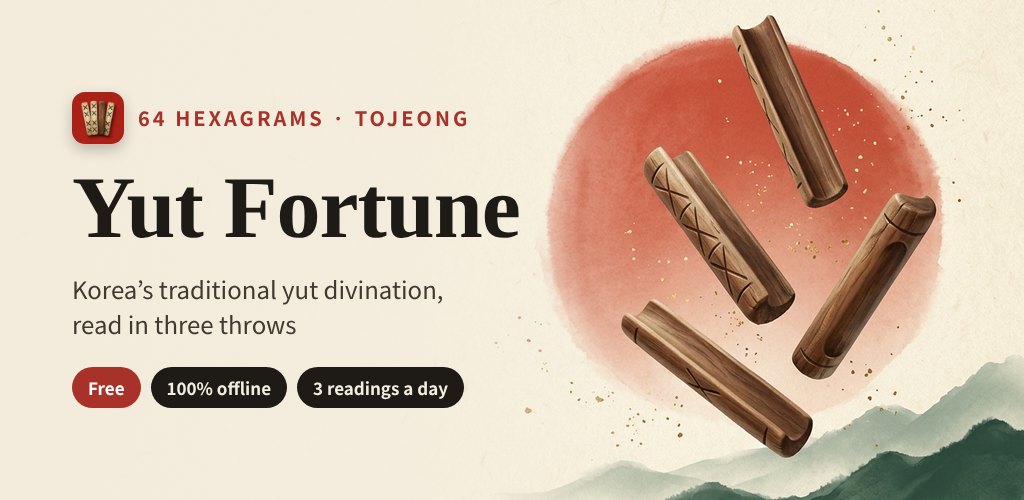
Every Lunar New Year, families gather over a yut board, and someone throws the sticks "just to see how the year will go." That little ritual — four wooden sticks tumbling onto a mat to read the day ahead — is older than any app, and most people only get to do it once a year. 정통 윷점 keeps it in your pocket for the other 364 days.
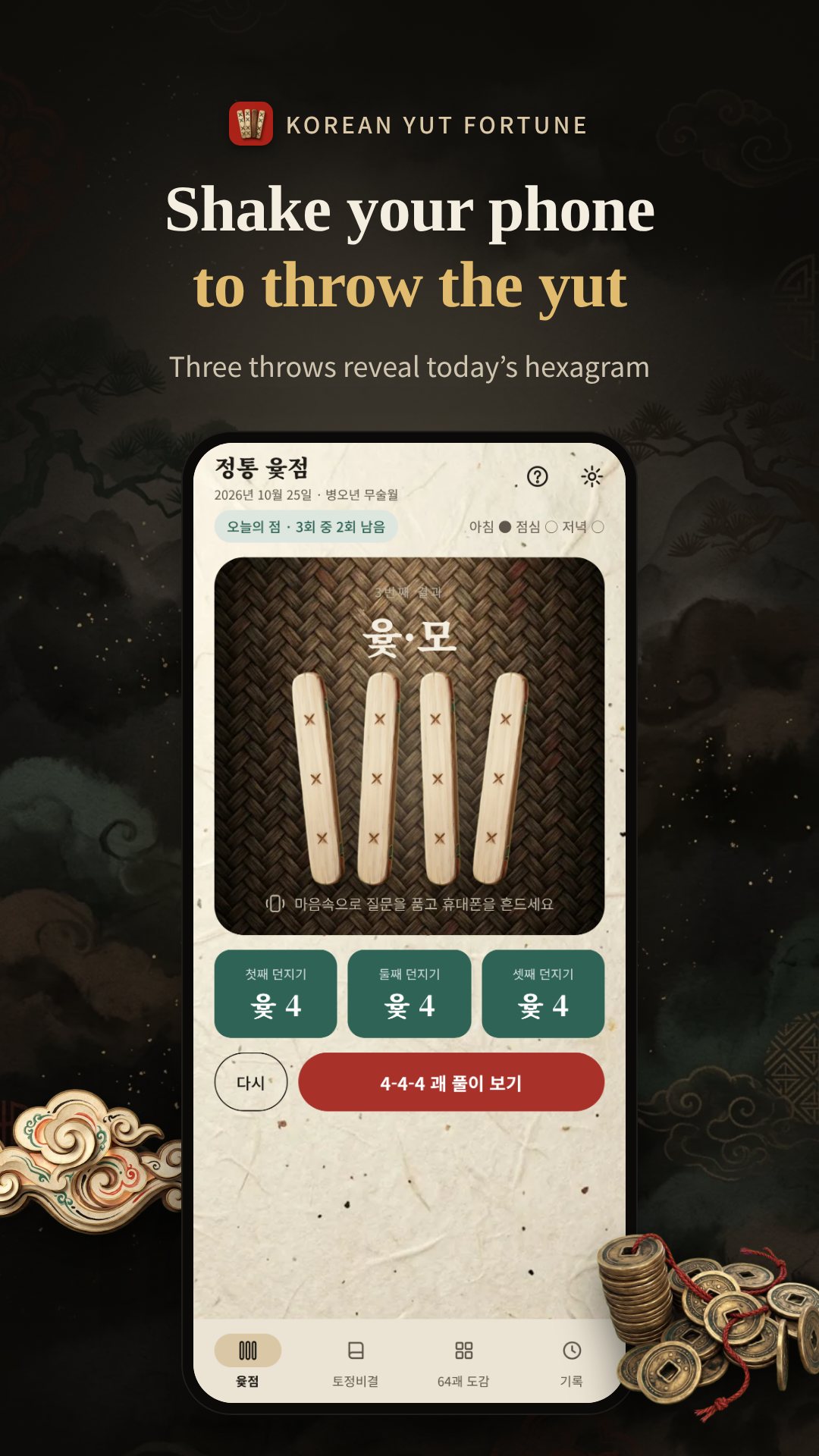
The app is built around real yut divination (윷점), not a random fortune generator. You hold a question in mind, shake the phone three times, and three throws pick one of 64 hexagrams (괘) — each with its own Korean name, hanja, and reading. Everything is computed on your device, so a morning fortune never waits for a signal.
The heart of the app is the throw. 정통 윷점 reads your phone's motion sensor, so a real shake tosses the four yut sticks on screen. Each stick lands flat-side or round-side up, and the count gives the classic values — 도 1, 개 2, 걸 3, 윷 4, and 모 (no flats, also 4). The sticks are even weighted to land flat slightly more often, the way carved yut behaves on a mat. Three throws in a row build a three-digit code from 1-1-1 to 4-4-4, and that code is your hexagram for this reading.
Don't want to shake? A tap button throws for you, and a sensitivity slider lets a light flick or a firm shake register the toss — useful on a crowded bus or for a device without an accelerometer.
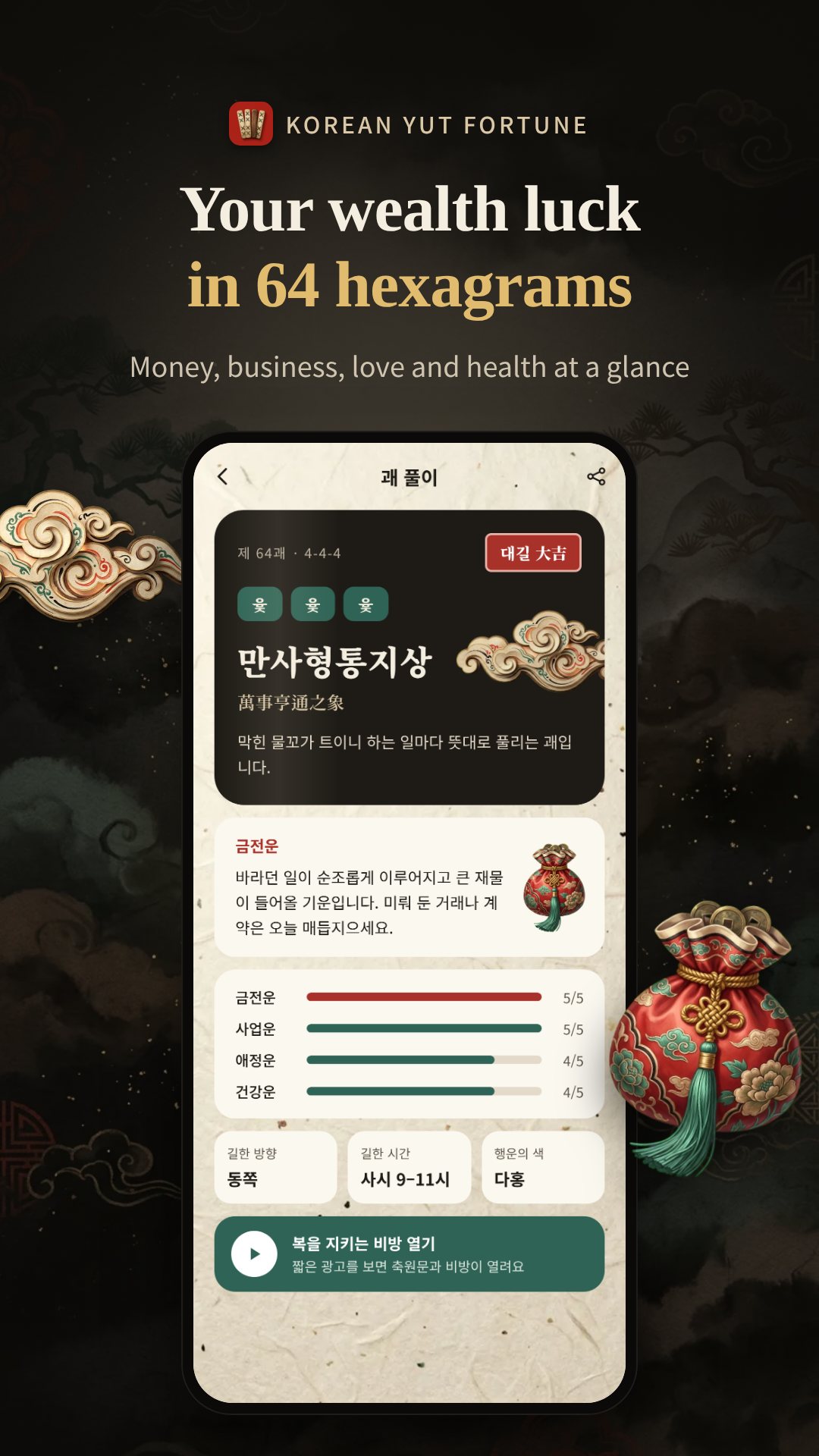
Each of the 64 hexagrams carries a Korean name and hanja (태평 太平, 춘풍 春風, 부귀 富貴…), a luck level from 1 (흉) to 5 (대길), and a one-line summary. Below that, the reading breaks the day into four areas — wealth, business, love and health — each with its own note, plus your lucky direction, lucky hour (given as a traditional double-hour such as 묘시 or 술시) and lucky colour for the day. Because the reading is derived from the hexagram code, the same throw always gives the same reading.
Every hexagram comes with a four-line blessing (축원문) and a set of rituals (비방) — small traditional actions keyed to whether the day is lucky, neutral or unlucky, and personalised with your direction and hour. A good day gets a luck-keeping ritual; a hard day gets a protective one. You can save or share the blessing card as an image to send to family.
Alongside the daily throw, 정통 윷점 includes a Tojeong-bigyeol (토정비결) yearly reading. Enter your birth date — solar or lunar, with leap-month support — and the app converts it through the Korean lunar calendar and your Korean count age to build the traditional three-part code (상괘 1–8, 중괘 1–6, 하괘 1–3, one of 144 combinations). You get a yearly verse, an overview, and a good / fair / caution reading for all twelve months.
Shake throws use your phone's accelerometer; if a device has none, the tap button works the same way. 정통 윷점 presents Korean yut divination and Tojeong for cultural, educational and entertainment use — it is not a substitute for professional advice on health, legal or financial matters. The app is free with ads, and an optional Premium removes them and raises the daily limit.
Yes. The throws, all 64 hexagram readings and the Tojeong calculation run on your device, so you can throw your yut with no connection.
There are 64, one for every three-throw combination from 1-1-1 to 4-4-4, each with its own name, hanja and reading.
No. Shaking is the fun way, but a tap button throws for you, and you can adjust how hard a shake needs to be.
Yes, it is free with ads and offers up to three readings a day; an optional Premium removes ads and allows up to nine.