 By the NAXTECH team · Published 12 Jul 2026 · Updated 24 Aug 2026 · Hands-on with v1.0
You type your name into a free gematria calculator, get a single number back, and have no idea which system it used or whether it would match the Arabic Abjad value your teacher quoted. Anyone who takes letter-value numerology seriously runs into the same wall: most apps pick one cipher, hide the method, and stop there. Gematria Cipher was built the other way round — it shows every classical system side by side and tells you exactly how each total was reached.
At its heart is an offline engine that computes seven letter-value ciphers for any name, word or phrase the moment you type it — verified against golden reference values so the numbers match the printed tables.
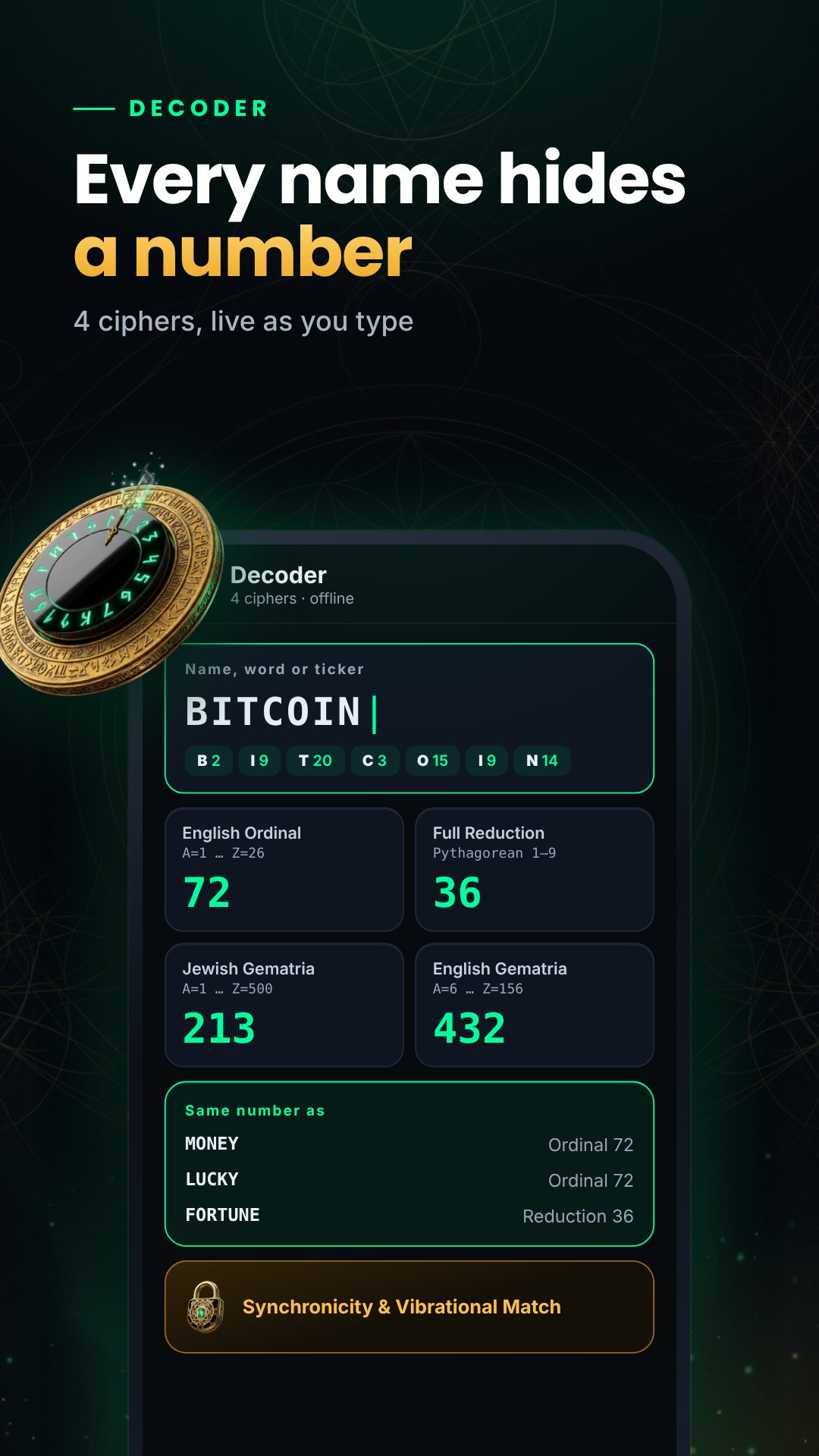
The Decoder is the main screen. As you type, it updates live and shows English Ordinal (A=1 to Z=26), Full Reduction (Pythagorean, each letter folded to 1–9), Jewish gematria, English gematria (ordinal × 6), Abjad al-Kabir, Abjad al-Saghir and native Hebrew (Mispar Hechrachi). Under the totals it lists the value of every letter and the digital root, so you can see precisely where a number comes from rather than trusting a black box.
Latin, Arabic and Hebrew letters are all handled in one field. Arabic support covers both the Mashriqi (Eastern) and Maghribi (Western) orders, counts written variants like hamza seats, ta marbuta and alif maqsura, and folds Persian and Urdu letters to their nearest Arabic base.
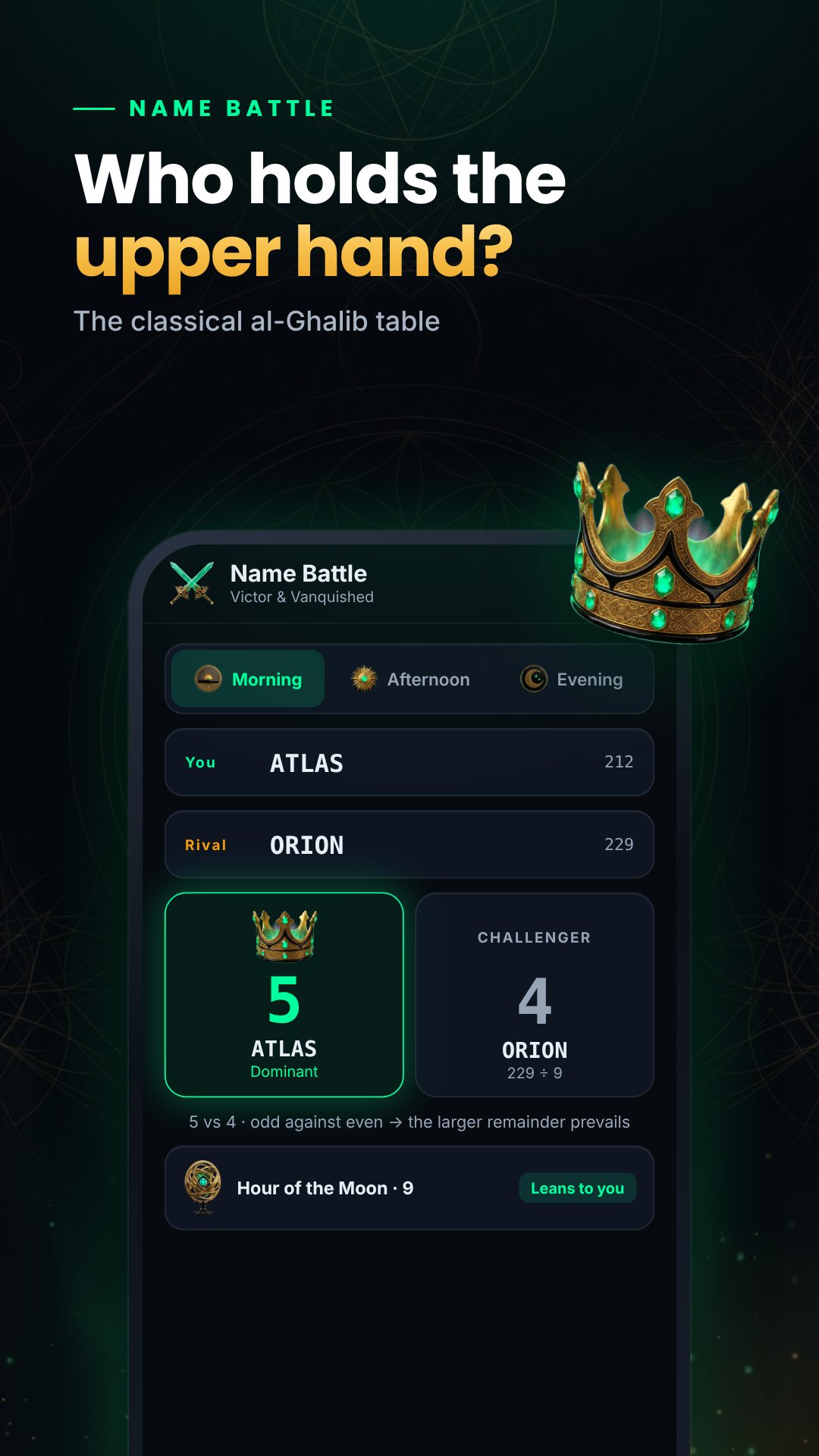
Name Battle settles which of two names prevails using the classical al-Ghalib wal-Maghlub ("Victor and Vanquished") method — the 45-pair table from the Shams al-Ma'arif. Each name's Abjad value is reduced modulo 9, and the winner follows the traditional rules: with the same parity the smaller number wins, odd against even the larger number wins, and on a tie the outcome turns on whether the shared number is odd or even. When your name loses, the app calculates a counter-number — the digit that would overcome your rival — so the result is a reading, not just a verdict.
Readings are weighted by the ruling planetary hour, computed in Chaldean order from local sunrise and sunset for the city you select, on that city's own wall-clock time. A battle can tell you whether the current hour favours your name, and whether a more favourable hour lies ahead — the kind of timing detail a traditional practitioner would check before acting.
The Ticker tool turns the same mathematics on a stock symbol, keyword or brand. It reduces the symbol to its root and compares it against the Daily Universal Value — the date's digits (YYYYMMDD) reduced to a single number, flagging the master numbers 11, 22 and 33 when they appear — then reports the symbol as resonant, favored or pressured for the day using the same al-Ghalib table.
Gematria Cipher presents traditional letter-value systems for cultural, educational and entertainment use; it is not a prediction of real events and does not replace professional advice on financial, legal or health matters. The interface is available in English, Arabic, Indonesian and Malay, with an option for Eastern Arabic digits. The app is free with ads and offers optional in-app purchases.
It computes English Ordinal, Full Reduction (Pythagorean), Jewish and English gematria, Abjad al-Kabir and al-Saghir, and native Hebrew — all at once as you type.
Yes. Every cipher, Name Battle and planetary-hour calculation runs on your device, with no account or connection required.
It compares two names with the classical al-Ghalib wal-Maghlub 45-pair table from the Shams al-Ma'arif to decide which prevails, and suggests a counter-number when yours loses.
Yes. It handles Arabic in both Mashriqi and Maghribi orders, Persian and Urdu variants, hamza and ta marbuta, plus native Hebrew with final forms.